What Happens to Your Work When an AI Tool Gets Killed

Models retire on a schedule and vendors shut down inside a year, so the reset is the default unless you build for it.

Technology
By Mark Choudhari · Jul 20, 2026 · 8 min read

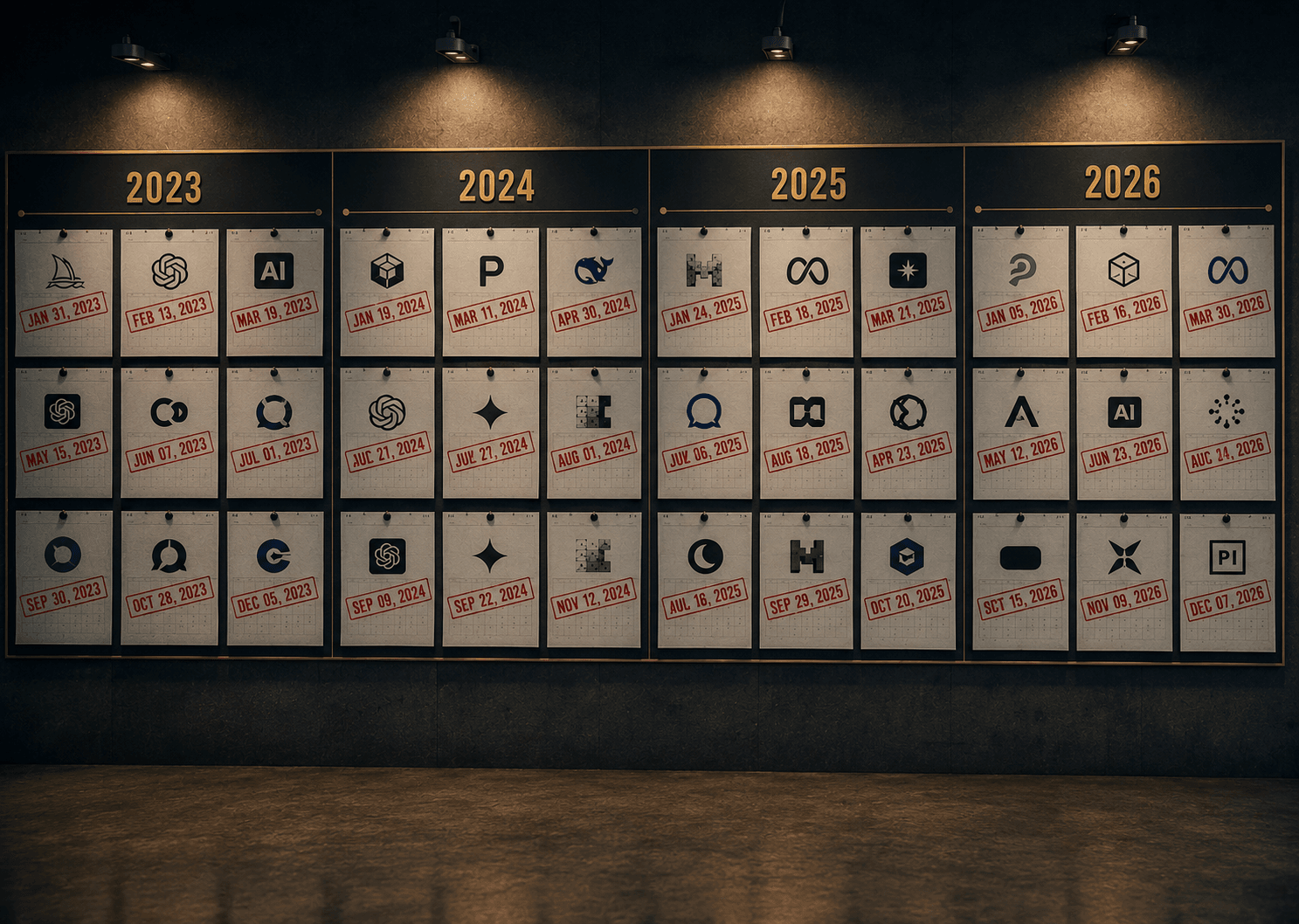
A wall calendar where a row of AI tool logos each has a red shutdown date stamped across it, left to right through 2023 to 2026.
Made with Works

TL;DR

AI tools and models get killed on a clock. Providers retire models on published deprecation calendars, well-funded vendors get shut down or acqui-hired inside a year or two, and a model update can change behavior and break automations even though nothing learned. When a tool is deprecated it stops on a set date and anything built directly on it resets. The durable answer is a layer held separate from any single model or vendor.

In this article

Which major AI tools and models have already been killed

More AI tools and models have been retired or shut down than most founder-led businesses realize, and the dates are on the record. Deprecation is the scheduled removal of a model or product on a set date, after which it stops working. Read the last three years as one motion and the reset stops looking like bad luck and starts looking like a calendar.

Start with the models, because the providers publish the dates themselves. OpenAI announced on January 29, 2026 that it would retire GPT-4o, GPT-4.1, GPT-4.1 mini, and OpenAI o4-mini from ChatGPT on February 13, 2026, about two weeks of notice, noting that only 0.1 percent of users still chose GPT-4o each day. That was the consumer app, not the API, where OpenAI said nothing changed at the time. On the developer side, OpenAI’s deprecations calendar lists the GPT-4 era shutting down in the API on October 23, 2026, the Assistants API removed on August 26, 2026, and DALL-E snapshots removed on May 12, 2026, with a minimum of six months of notice for generally available models and as little as two weeks for previews. At the shutdown date the model becomes inaccessible and fine-tuned variants built on it stop working.

The same lifecycle runs at other providers. Anthropic gives at least sixty days of notice and lists its own retirements: Claude 3 Opus retired January 5, 2026, and Claude Sonnet 4 and Claude Opus 4 both retired June 15, 2026, at which point calls to them fail. These are cited here only as dated facts, not one model measured against another.

The shutdowns reach past models to whole products, including some of the best-funded names in AI. Olive AI, a healthcare automation startup once valued at 4 billion dollars, announced on October 31, 2023 that it would shut down and sell off its remaining businesses. The news app Artifact, from the Instagram founders, announced its wind-down on January 12, 2024 and went dark by early April. Inflection had raised more than 1.3 billion dollars at a 4 billion dollar valuation, and in March 2024 Microsoft hired its co-founders and most of its roughly seventy-person team, leaving the Pi product a shell. On June 28, 2024, Amazon hired Adept’s chief executive and co-founders onto its own team; Adept had raised a $350 million Series B. On August 2, 2024, Character.AI’s co-founders rejoined Google under a licensing deal reported at a 2.5 billion dollar valuation. And on December 27, 2024, Bench, a bookkeeping platform with more than 35,000 US customers, went dark and took its app offline the same day, days before tax season, though it was later acquired and relaunched in January 2025.

More AI tools and models have already been retired or shut down than most founder-led businesses realize, and every one of them ran on a date someone else set.

What happens to your work when an AI tool or model is deprecated

When a tool or model is deprecated, it stops working on a set date, and any automation, prompt, or configuration built directly on it breaks or resets. A fine-tuned model becomes inaccessible at its shutdown date, so anything trained on top of it goes with it. A workflow wired to a specific model returns errors or silently different results once that model is gone. The setup you built, the instructions, the context, the connections, was locked to a thing with an expiry, so the accumulated work returns toward zero on the shutdown date rather than carrying forward.

This is why a retirement lands as more than an inconvenience. It is not the ten minutes to swap a setting. It is the reorientation underneath: rebuilding what worked, re-testing what broke, and re-establishing the context the old setup held. The precise dollar count of that repeated repair is its own accounting, covered in the maintenance tax, and the cost of moving off a tool you had committed to sits in the switching tax. The point here is why the bill keeps arriving at all.

Your AI model is being retired, what to do now

The immediate move is practical: find the provider’s deprecation notice, note the shutdown date, and identify everything wired to that model, the automations, the fine-tuned variants, the prompts tuned to its quirks. Providers publish these schedules, so the date is knowable in advance rather than a surprise.

The deeper move is to change where the durable part of your setup lives so the next retirement costs less than this one. If your context and configuration live inside the model or the single tool being retired, every retirement is a rebuild. If they live in a layer that sits above any one model, a retirement becomes a swap underneath rather than a reset on top. The reassurance that a swappable model does not have to mean vendor lock-in, and the architecture that makes it real, is laid out in why vendor lock-in does not have to be the price of AI.

Why your AI behaves differently after an update even though it did not learn

Behavior can change with no shutdown at all. The model served behind a stable name gets re-tuned or replaced, so the same prompt starts returning different results. Nothing on your side changed, and the model did not learn anything about you. The thing answering your call was quietly updated, and downstream automations drift because they were calibrated against the old behavior.

This is worth naming because it is invisible until something breaks. A report that used to come out clean starts formatting oddly. A classification step that was reliable starts missing edge cases. There was no announcement, because from the provider’s side the model simply improved or was replaced under the same label. The practical defense is to watch the output rather than trust the name, and to hold your own tested configuration in a place a silent update cannot overwrite.

How to build so a vendor shutdown does not reset you

The reset ends when the durable part of your AI is held separate from the swappable part. Your business context, your configuration, and your operating knowledge live in one place you hold. The model plugs in underneath and is allowed to retire, drift, or be replaced without reaching up to reset the work on top. Practitioner guidance on avoiding AI vendor lock-in reaches the same conclusion: keep your own data, context, and prompts as the system of record rather than inside any one model or closed framework.

This is the separation Works is built on. The business it learns lives in Areas, Categories, and Notebooks, smart folders that read their own contents and feed the next piece of work, and that business layer is kept apart from the models underneath. So when a model retires or a tool goes dark, the layer stays intact, and new models land inside the setup you already have rather than asking you to start over. A workspace built months ago still runs on today’s version with no re-setup. The investment carries forward instead of resetting on someone else’s calendar.

That idea sits inside a larger one, that AI can be an appreciating asset instead of a sunk cost, which is the through-line of Compounding AI. If you want to see the separation running before the public launch, survive the next AI sunset and sign up for early access.

You cannot stop the sunsets. You can stop the sunset resetting your work.

Common Questions

Will my automations break when the model behind them changes?

They can, in two ways. If the model is deprecated, it stops on its shutdown date and any automation calling it fails outright. If the model is quietly re-tuned or replaced under the same name, the automation keeps running but returns different results, which is harder to catch. The defense is to monitor the output and hold your configuration in a layer a model change cannot overwrite.

Are tools from big, well-funded AI vendors safe from being shut down?

Funding is not protection. Inflection had raised more than 1.3 billion dollars, Olive AI was valued at 4 billion dollars, and Adept had raised a $350 million Series B, and each was shut down or absorbed inside a year or two. Well-funded startups have been shutting down and getting absorbed at a rising pace, not a falling one. Size lengthens the runway; it does not remove the shutdown risk.

What does it mean when an AI model is deprecated?

Deprecation is the scheduled removal of a model on a set date. Before that date the model still works but is marked for retirement; on the date it becomes inaccessible and fine-tuned variants built on it stop working. Providers publish these calendars in advance, so the shutdown is knowable, which is exactly why the setup built on it should not be locked to it.

What happens to my work when an AI tool I rely on shuts down?

Anything built directly on that tool, the automations, the prompts, the configuration, and the context you loaded, resets when the tool goes dark, because it was held inside the tool. Work stored in a separate layer you control carries forward. The difference on shutdown day is entirely about where your setup was living beforehand.

Get Started With AI

Are You Ready to Make AI Work for You?

Simplify your AI journey with solutions that integrate seamlessly, empower your teams, and deliver real results. Jyn turns complexity into a clear path to success.

See AI for Real Business Impact in Action →

ai that powers your team 226d8ee5db

What Happens to Your Work When an AI Tool Gets Killed

Models retire on a schedule and vendors shut down inside a year, so the reset is the default unless you build for it.
Technology
By Mark Choudhari · Jul 20, 2026 · 8 min read

A wall calendar where a row of AI tool logos each has a red shutdown date stamped across it, left to right through 2023 to 2026.
Made with Works

TL;DR

AI tools and models get killed on a clock. Providers retire models on published deprecation calendars, well-funded vendors get shut down or acqui-hired inside a year or two, and a model update can change behavior and break automations even though nothing learned. When a tool is deprecated it stops on a set date and anything built directly on it resets. The durable answer is a layer held separate from any single model or vendor.

In this article

Which major AI tools and models have already been killed

More AI tools and models have been retired or shut down than most founder-led businesses realize, and the dates are on the record. Deprecation is the scheduled removal of a model or product on a set date, after which it stops working. Read the last three years as one motion and the reset stops looking like bad luck and starts looking like a calendar.

Start with the models, because the providers publish the dates themselves. OpenAI announced on January 29, 2026 that it would retire GPT-4o, GPT-4.1, GPT-4.1 mini, and OpenAI o4-mini from ChatGPT on February 13, 2026, about two weeks of notice, noting that only 0.1 percent of users still chose GPT-4o each day. That was the consumer app, not the API, where OpenAI said nothing changed at the time. On the developer side, OpenAI’s deprecations calendar lists the GPT-4 era shutting down in the API on October 23, 2026, the Assistants API removed on August 26, 2026, and DALL-E snapshots removed on May 12, 2026, with a minimum of six months of notice for generally available models and as little as two weeks for previews. At the shutdown date the model becomes inaccessible and fine-tuned variants built on it stop working.

The same lifecycle runs at other providers. Anthropic gives at least sixty days of notice and lists its own retirements: Claude 3 Opus retired January 5, 2026, and Claude Sonnet 4 and Claude Opus 4 both retired June 15, 2026, at which point calls to them fail. These are cited here only as dated facts, not one model measured against another.

The shutdowns reach past models to whole products, including some of the best-funded names in AI. Olive AI, a healthcare automation startup once valued at 4 billion dollars, announced on October 31, 2023 that it would shut down and sell off its remaining businesses. The news app Artifact, from the Instagram founders, announced its wind-down on January 12, 2024 and went dark by early April. Inflection had raised more than 1.3 billion dollars at a 4 billion dollar valuation, and in March 2024 Microsoft hired its co-founders and most of its roughly seventy-person team, leaving the Pi product a shell. On June 28, 2024, Amazon hired Adept’s chief executive and co-founders onto its own team; Adept had raised a $350 million Series B. On August 2, 2024, Character.AI’s co-founders rejoined Google under a licensing deal reported at a 2.5 billion dollar valuation. And on December 27, 2024, Bench, a bookkeeping platform with more than 35,000 US customers, went dark and took its app offline the same day, days before tax season, though it was later acquired and relaunched in January 2025.

More AI tools and models have already been retired or shut down than most founder-led businesses realize, and every one of them ran on a date someone else set.

What happens to your work when an AI tool or model is deprecated

When a tool or model is deprecated, it stops working on a set date, and any automation, prompt, or configuration built directly on it breaks or resets. A fine-tuned model becomes inaccessible at its shutdown date, so anything trained on top of it goes with it. A workflow wired to a specific model returns errors or silently different results once that model is gone. The setup you built, the instructions, the context, the connections, was locked to a thing with an expiry, so the accumulated work returns toward zero on the shutdown date rather than carrying forward.

This is why a retirement lands as more than an inconvenience. It is not the ten minutes to swap a setting. It is the reorientation underneath: rebuilding what worked, re-testing what broke, and re-establishing the context the old setup held. The precise dollar count of that repeated repair is its own accounting, covered in the maintenance tax, and the cost of moving off a tool you had committed to sits in the switching tax. The point here is why the bill keeps arriving at all.

Your AI model is being retired, what to do now

The immediate move is practical: find the provider’s deprecation notice, note the shutdown date, and identify everything wired to that model, the automations, the fine-tuned variants, the prompts tuned to its quirks. Providers publish these schedules, so the date is knowable in advance rather than a surprise.

The deeper move is to change where the durable part of your setup lives so the next retirement costs less than this one. If your context and configuration live inside the model or the single tool being retired, every retirement is a rebuild. If they live in a layer that sits above any one model, a retirement becomes a swap underneath rather than a reset on top. The reassurance that a swappable model does not have to mean vendor lock-in, and the architecture that makes it real, is laid out in why vendor lock-in does not have to be the price of AI.

Why your AI behaves differently after an update even though it did not learn

Behavior can change with no shutdown at all. The model served behind a stable name gets re-tuned or replaced, so the same prompt starts returning different results. Nothing on your side changed, and the model did not learn anything about you. The thing answering your call was quietly updated, and downstream automations drift because they were calibrated against the old behavior.

This is worth naming because it is invisible until something breaks. A report that used to come out clean starts formatting oddly. A classification step that was reliable starts missing edge cases. There was no announcement, because from the provider’s side the model simply improved or was replaced under the same label. The practical defense is to watch the output rather than trust the name, and to hold your own tested configuration in a place a silent update cannot overwrite.

How to build so a vendor shutdown does not reset you

The reset ends when the durable part of your AI is held separate from the swappable part. Your business context, your configuration, and your operating knowledge live in one place you hold. The model plugs in underneath and is allowed to retire, drift, or be replaced without reaching up to reset the work on top. Practitioner guidance on avoiding AI vendor lock-in reaches the same conclusion: keep your own data, context, and prompts as the system of record rather than inside any one model or closed framework.

This is the separation Works is built on. The business it learns lives in Areas, Categories, and Notebooks, smart folders that read their own contents and feed the next piece of work, and that business layer is kept apart from the models underneath. So when a model retires or a tool goes dark, the layer stays intact, and new models land inside the setup you already have rather than asking you to start over. A workspace built months ago still runs on today’s version with no re-setup. The investment carries forward instead of resetting on someone else’s calendar.

That idea sits inside a larger one, that AI can be an appreciating asset instead of a sunk cost, which is the through-line of Compounding AI. If you want to see the separation running before the public launch, survive the next AI sunset and sign up for early access.

You cannot stop the sunsets. You can stop the sunset resetting your work.

Common Questions

Will my automations break when the model behind them changes?

They can, in two ways. If the model is deprecated, it stops on its shutdown date and any automation calling it fails outright. If the model is quietly re-tuned or replaced under the same name, the automation keeps running but returns different results, which is harder to catch. The defense is to monitor the output and hold your configuration in a layer a model change cannot overwrite.

Are tools from big, well-funded AI vendors safe from being shut down?

Funding is not protection. Inflection had raised more than 1.3 billion dollars, Olive AI was valued at 4 billion dollars, and Adept had raised a $350 million Series B, and each was shut down or absorbed inside a year or two. Well-funded startups have been shutting down and getting absorbed at a rising pace, not a falling one. Size lengthens the runway; it does not remove the shutdown risk.

What does it mean when an AI model is deprecated?

Deprecation is the scheduled removal of a model on a set date. Before that date the model still works but is marked for retirement; on the date it becomes inaccessible and fine-tuned variants built on it stop working. Providers publish these calendars in advance, so the shutdown is knowable, which is exactly why the setup built on it should not be locked to it.

What happens to my work when an AI tool I rely on shuts down?

Anything built directly on that tool, the automations, the prompts, the configuration, and the context you loaded, resets when the tool goes dark, because it was held inside the tool. Work stored in a separate layer you control carries forward. The difference on shutdown day is entirely about where your setup was living beforehand.

Get Started With AI

Are You Ready to Make AI Work for You?

Simplify your AI journey with solutions that integrate seamlessly, empower your teams, and deliver real results. Jyn turns complexity into a clear path to success.


See AI for Real Business Impact in Action →

ai that powers your team 226d8ee5db