Why Your AI Setup Starts Over Every Time a New Tool Ships

The work you redo with every new model is a design flaw, not a discipline flaw, and it can be switched off.

Technology
By Mark Choudhari · Jul 20, 2026 · 7 min read

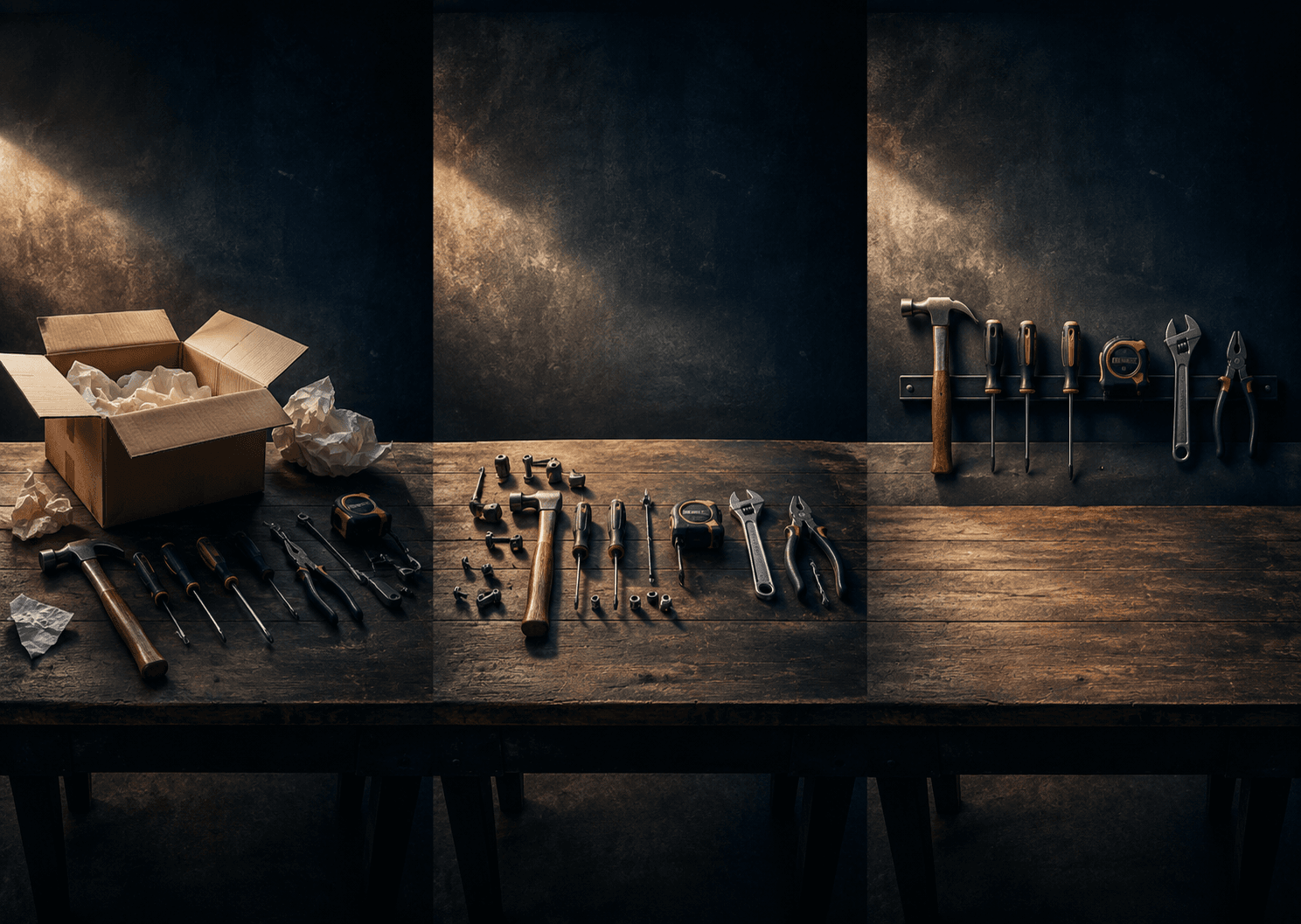
A workshop bench where the same tools are being unpacked and rebuilt three times over, left to right.
Made with Works

Why you start over every time a new AI tool comes out

The reset tax is the work a founder-led business redoes every time a new AI tool or model arrives: re-uploading the same business context, rebuilding the same instructions, rewriting the same prompts. It happens because most AI tools do not keep state and their setup is locked to one tool, so the effort resets to zero on every switch. It is the recurring face of the AI Tax, the one nobody itemizes, and the reason your AI can feel like it never quite gets ahead.

You can date it because you lived it. OpenAI shipped Custom GPTs on November 6, 2023, noting that power users were already copying carefully crafted prompt lists into ChatGPT by hand, the exact re-typing the feature was built to hold. Anthropic then launched Projects on June 25, 2024, with per-project knowledge and instructions, under the heading “avoid the cold start problem”. That is the reset tax stated by the vendor. If you loaded style guides and context into GPTs, you loaded the same material again into a second, separate place. Each arrival asked for the setup one more time.

Why your AI tools cannot remember your business on their own

The cause is not forgetfulness. A language model is a stateless function. Each call runs over the full input, produces its output, then discards the intermediate computation, so nothing persists to the next call. What looks like memory in a chat is the application re-sending the earlier turns, not the model holding anything. This is a property of the transformer architecture described in 2017, the same design that makes these models fast to scale.

Because the continuity lives in the application layer rather than in the model, each tool keeps its own isolated store, and setup built in one does not travel to another on its own. So the reset is baked into how the tools are put together. It is not a sign you skipped a step. The model cannot carry your business by itself, and its configuration was never built to move.

The reset is not you forgetting to save. The tool cannot carry your business on its own, and its setup was never built to travel.

How much the new AI tool treadmill costs over a year

There is no clean AI-specific figure for hours lost per year, and we will not invent one. What research does show is that reorientation is expensive. In a controlled study, interrupted work gets finished faster but at a measured cost: after about twenty minutes, people report significantly higher stress, frustration, and effort. Read it as direction, not an AI-specific receipt: re-establishing context in a new tool carries the same repeated cost.

The setup work itself is not a quick re-paste either. Practitioner and academic writing on moving a working prompt stack to a new model treats it as a project measured in weeks, not minutes. Multiply a weeks-long migration across the cadence of new tools and models a founder faces, and the treadmill is real even without a tidy annual number. The precise dollar tally of switching and subscriptions is a separate accounting, covered in the switching tax and the full AI tax. This is about why the tally keeps recurring at all.

Whether the work you put into one tool carries to the next

Mostly, it does not. The prompts, the instructions, the uploaded context, and the custom setup you built live inside one tool’s own store. Move to a new tool and almost none of it comes with you, because there is no shared layer holding it. Providers know this is a pain and have started shipping fixes, which is the honest part of the picture, and it is covered below under compounding.

Why your AI setup does not compound the way you expected

You expected each month of setup to stack on the last. Instead it flattens. Compounding needs a base that persists, and there is no persistent base when every tool starts you at zero. The model makers reinforce this in their own instructions. OpenAI’s guidance for a new model family tells you to treat it as something to tune for, not a drop-in replacement, and to begin migration from a fresh baseline rather than carrying over your older prompt stack. When the instruction is to start from a fresh baseline, the setup is being asked to reset on a schedule you do not control. That is why the curve you wanted, up and to the right, keeps snapping back to the floor.

How to stop redoing your AI setup every few months

The only thing that stops the reset is holding the durable part separate from the swappable part. Memory, context, and configuration go in one place. The model plugs in underneath and can change without starting you over. Engineering writing on model-agnostic memory describes exactly this: once memory lives outside the model, you are no longer locked to a single provider, the memory layer becomes the constant, and the models become interchangeable. Keep the business in the layer that stays; let the intelligence underneath improve on its own clock.

What it takes for your AI investment to stop resetting to zero

This is where the fix becomes concrete. Works is built on that separation. The business it learns lives in Areas, Categories, and Notebooks, smart folders that read their own contents and feed the next piece of work, so a prospect’s call notes and emails inform the next draft without anyone pasting them in. That business layer sits apart from the models underneath. When the underlying models change, the business the system already learned stays learned, so a six-month-old workspace runs on today’s version with no re-setup. The investment compounds instead of resetting.

If you want to see that separation running before the public launch, sign up for early access. If you would rather read the longer argument first, the full breakdown of why the reset happens and what turns it off lays it out end to end. This whole idea sits inside a larger one, that AI can be an appreciating asset instead of a sunk cost, which is the through-line of Compounding AI and its sibling on why your AI investment should hold its value.

You do not have a discipline problem. You have an architecture problem, and for the first time it is one you can actually fix.

Common Questions

Is my constant AI-tool switching a discipline problem or a built-in one?

It is built-in. The reset comes from how the tools are designed, not from how organized you are. Language models do not keep state, and each tool locks its setup to itself, so the effort resets on every switch no matter how disciplined you are. The fix is architecture, holding your context separate from the model, not more rigor.

Do the built-in memory features in ChatGPT and Claude solve this?

Partly, and only inside one tool. Providers added persistent memory that reduces re-explaining within their own product, but each store stays locked to its own ecosystem and cannot be used with other models. So native memory eases the reset in the room you are in, and the cross-tool reset returns the moment you switch.

Why does my AI feel like it never gets ahead?

Because the setup keeps starting from zero. Without a layer that holds business context across tools and model upgrades, each month of work does not stack on the last, so effort flattens instead of compounding. Getting ahead requires a durable base the models plug into, rather than a fresh rebuild each time.

What is the reset tax?

The reset tax is the setup a founder-led business redoes every time a new AI tool or model arrives: the same context re-uploaded, the same instructions rebuilt, the same prompts rewritten. It is a recurring cost because AI tools do not keep state and their configuration is not portable, so switching returns the effort to zero.

Get Started With AI

Are You Ready to Make AI Work for You?

Simplify your AI journey with solutions that integrate seamlessly, empower your teams, and deliver real results. Jyn turns complexity into a clear path to success.

See AI for Real Business Impact in Action →

ai that powers your team 226d8ee5db

Why Your AI Setup Starts Over Every Time a New Tool Ships

The work you redo with every new model is a design flaw, not a discipline flaw, and it can be switched off.
Technology
By Mark Choudhari · Jul 20, 2026 · 7 min read

A workshop bench where the same tools are being unpacked and rebuilt three times over, left to right.
Made with Works

Why you start over every time a new AI tool comes out

The reset tax is the work a founder-led business redoes every time a new AI tool or model arrives: re-uploading the same business context, rebuilding the same instructions, rewriting the same prompts. It happens because most AI tools do not keep state and their setup is locked to one tool, so the effort resets to zero on every switch. It is the recurring face of the AI Tax, the one nobody itemizes, and the reason your AI can feel like it never quite gets ahead.

You can date it because you lived it. OpenAI shipped Custom GPTs on November 6, 2023, noting that power users were already copying carefully crafted prompt lists into ChatGPT by hand, the exact re-typing the feature was built to hold. Anthropic then launched Projects on June 25, 2024, with per-project knowledge and instructions, under the heading “avoid the cold start problem”. That is the reset tax stated by the vendor. If you loaded style guides and context into GPTs, you loaded the same material again into a second, separate place. Each arrival asked for the setup one more time.

Why your AI tools cannot remember your business on their own

The cause is not forgetfulness. A language model is a stateless function. Each call runs over the full input, produces its output, then discards the intermediate computation, so nothing persists to the next call. What looks like memory in a chat is the application re-sending the earlier turns, not the model holding anything. This is a property of the transformer architecture described in 2017, the same design that makes these models fast to scale.

Because the continuity lives in the application layer rather than in the model, each tool keeps its own isolated store, and setup built in one does not travel to another on its own. So the reset is baked into how the tools are put together. It is not a sign you skipped a step. The model cannot carry your business by itself, and its configuration was never built to move.

The reset is not you forgetting to save. The tool cannot carry your business on its own, and its setup was never built to travel.

How much the new AI tool treadmill costs over a year

There is no clean AI-specific figure for hours lost per year, and we will not invent one. What research does show is that reorientation is expensive. In a controlled study, interrupted work gets finished faster but at a measured cost: after about twenty minutes, people report significantly higher stress, frustration, and effort. Read it as direction, not an AI-specific receipt: re-establishing context in a new tool carries the same repeated cost.

The setup work itself is not a quick re-paste either. Practitioner and academic writing on moving a working prompt stack to a new model treats it as a project measured in weeks, not minutes. Multiply a weeks-long migration across the cadence of new tools and models a founder faces, and the treadmill is real even without a tidy annual number. The precise dollar tally of switching and subscriptions is a separate accounting, covered in the switching tax and the full AI tax. This is about why the tally keeps recurring at all.

Whether the work you put into one tool carries to the next

Mostly, it does not. The prompts, the instructions, the uploaded context, and the custom setup you built live inside one tool’s own store. Move to a new tool and almost none of it comes with you, because there is no shared layer holding it. Providers know this is a pain and have started shipping fixes, which is the honest part of the picture, and it is covered below under compounding.

Why your AI setup does not compound the way you expected

You expected each month of setup to stack on the last. Instead it flattens. Compounding needs a base that persists, and there is no persistent base when every tool starts you at zero. The model makers reinforce this in their own instructions. OpenAI’s guidance for a new model family tells you to treat it as something to tune for, not a drop-in replacement, and to begin migration from a fresh baseline rather than carrying over your older prompt stack. When the instruction is to start from a fresh baseline, the setup is being asked to reset on a schedule you do not control. That is why the curve you wanted, up and to the right, keeps snapping back to the floor.

How to stop redoing your AI setup every few months

The only thing that stops the reset is holding the durable part separate from the swappable part. Memory, context, and configuration go in one place. The model plugs in underneath and can change without starting you over. Engineering writing on model-agnostic memory describes exactly this: once memory lives outside the model, you are no longer locked to a single provider, the memory layer becomes the constant, and the models become interchangeable. Keep the business in the layer that stays; let the intelligence underneath improve on its own clock.

What it takes for your AI investment to stop resetting to zero

This is where the fix becomes concrete. Works is built on that separation. The business it learns lives in Areas, Categories, and Notebooks, smart folders that read their own contents and feed the next piece of work, so a prospect’s call notes and emails inform the next draft without anyone pasting them in. That business layer sits apart from the models underneath. When the underlying models change, the business the system already learned stays learned, so a six-month-old workspace runs on today’s version with no re-setup. The investment compounds instead of resetting.

If you want to see that separation running before the public launch, sign up for early access. If you would rather read the longer argument first, the full breakdown of why the reset happens and what turns it off lays it out end to end. This whole idea sits inside a larger one, that AI can be an appreciating asset instead of a sunk cost, which is the through-line of Compounding AI and its sibling on why your AI investment should hold its value.

You do not have a discipline problem. You have an architecture problem, and for the first time it is one you can actually fix.

Common Questions

Is my constant AI-tool switching a discipline problem or a built-in one?

It is built-in. The reset comes from how the tools are designed, not from how organized you are. Language models do not keep state, and each tool locks its setup to itself, so the effort resets on every switch no matter how disciplined you are. The fix is architecture, holding your context separate from the model, not more rigor.

Do the built-in memory features in ChatGPT and Claude solve this?

Partly, and only inside one tool. Providers added persistent memory that reduces re-explaining within their own product, but each store stays locked to its own ecosystem and cannot be used with other models. So native memory eases the reset in the room you are in, and the cross-tool reset returns the moment you switch.

Why does my AI feel like it never gets ahead?

Because the setup keeps starting from zero. Without a layer that holds business context across tools and model upgrades, each month of work does not stack on the last, so effort flattens instead of compounding. Getting ahead requires a durable base the models plug into, rather than a fresh rebuild each time.

What is the reset tax?

The reset tax is the setup a founder-led business redoes every time a new AI tool or model arrives: the same context re-uploaded, the same instructions rebuilt, the same prompts rewritten. It is a recurring cost because AI tools do not keep state and their configuration is not portable, so switching returns the effort to zero.

Get Started With AI

Are You Ready to Make AI Work for You?

Simplify your AI journey with solutions that integrate seamlessly, empower your teams, and deliver real results. Jyn turns complexity into a clear path to success.


See AI for Real Business Impact in Action →

ai that powers your team 226d8ee5db