A founder’s-seat retrospective of four years of AI, and why 2026 is the year capability stopped being the point.

A founder’s-seat retrospective of four years of AI, and why 2026 is the year capability stopped being the point.
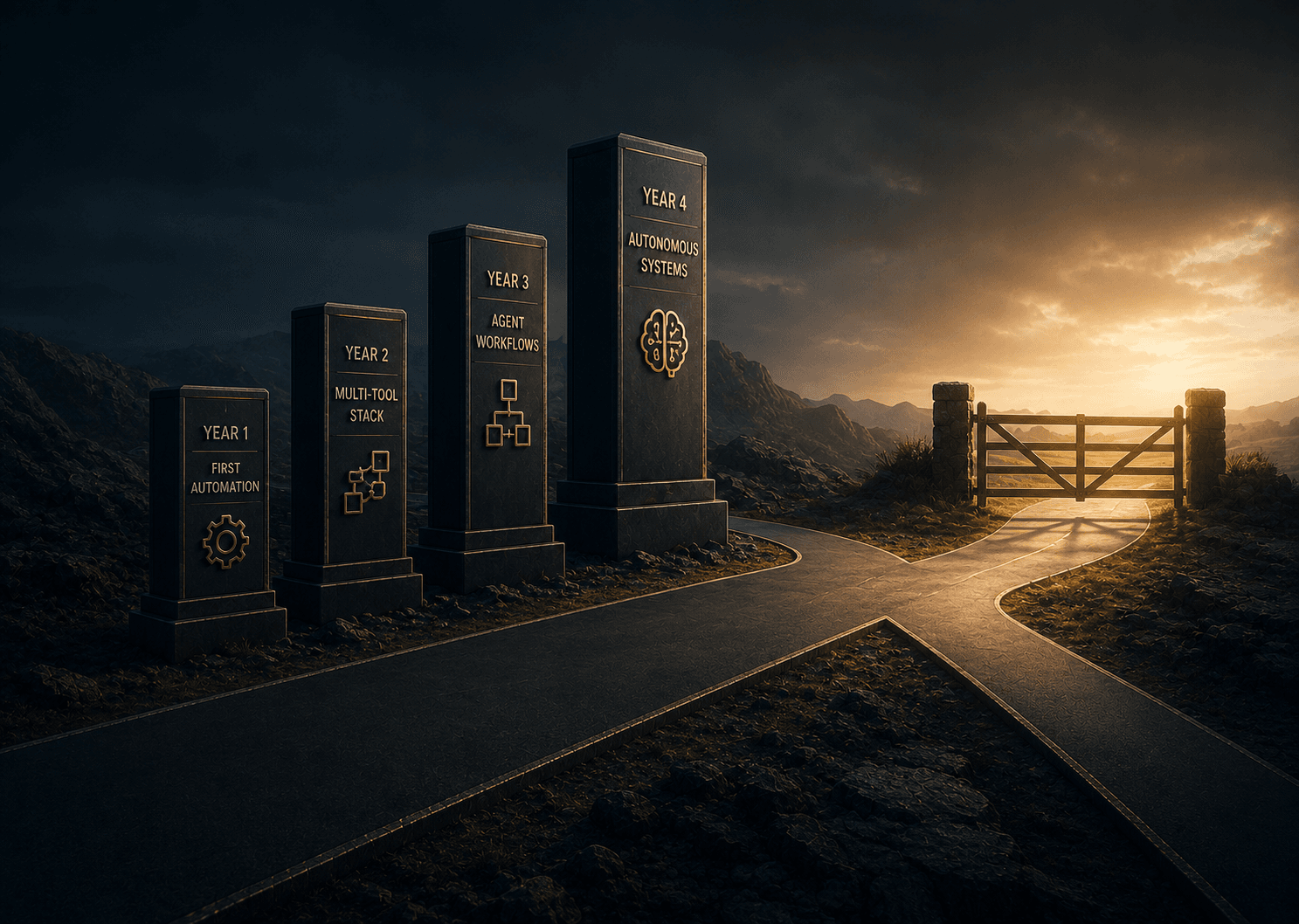
From late 2022 to 2026, AI for business moved through four waves of capability, fluent chat, reasoning, multimodal, and agents, each promising the same transformation. What changed in 2026 was not another capability. It was the altitude of the question, from what AI can do to what runs the business. That is the operations inflection, and it is where the four-year arc was always heading.
Most timelines of this era are version histories. They list which model shipped when, which benchmark it beat, which feature followed. That is the history of the tools. This is the history of the buyer: what a founder felt and tried at each step, and why the thing that finally mattered was not a capability at all. We map it to the journey founders actually lived, from FOMO to fatigue to a finally honest question, because the dates only make sense once you put a founder in the chair next to them.
The history of AI for business from 2022 to 2026 is four years of rising capability and one year of changing the question. A fluent chat assistant arrived in late 2022 and started the FOMO. Reasoning and early tool use followed through 2023. Seeing, hearing, and heavier reasoning broadened the field in 2024. Cheaper reasoning and agents spread in 2025. In 2026 the question itself moved, from what AI can do to what runs the business.
The shape matters more than any single date. For four straight years, the headline was a new capability, and the founder’s job was to keep up with it. The pace was real, and it never let up: the fluent chat assistant that started it all went to a publicly accessible, intelligent-conversation model in late 2022, and every year since added another capability to track. Keeping current became a standing job. The short version is that every wave was sold as the one that would run your company, and four years in, almost none of it did, which is exactly the gap 2026 set out to close.
Since the chat assistant launched, AI for business has changed from a capability race into an operations question. In 2022 the change was that anyone could get a fluent draft in seconds. By 2025 capability had stopped being the bottleneck at all, which forced a harder question into the open: if these tools can do almost anything, why has the business outcome barely moved?
That question explains the arc better than any benchmark. The FOMO of the early years, the fragmented stack that piled up by 2024, the quiet disappointment of 2025 of capable tools and flat results, all of it is the same journey founders lived through together. (We cover the journey in full in the five phases of AI maturity.) None of this is a knock on the tools. Each wave delivered what it promised. The gap was that a tool doing a task faster is not the same as a business running better, and four years of better tools never closed that gap because they were never aimed at it.
The evidence sits right on top of the felt experience. While nearly every company now uses AI somewhere, the overwhelming majority still report no measurable return on it, with widely cited 2025 research putting the share of generative-AI pilots that deliver no return at roughly 95 percent, the number the whole capability pillar is built around. That is not a story about weak models. The models got better every year on this timeline. It is a story about altitude. The effort went into adopting capability, and capability was never the thing that runs a business.
AI became useful for running a company in 2026, when the question changed. Not because a single model crossed a line, but because the conversation finally moved from what can AI do to what runs the business. AI becomes useful for running a company at the moment it stops being a faster task tool and starts owning work end to end, against your real context.
This is the turn the whole timeline was building toward. For four years the answer to AI overwhelm was always another capability, and another capability never resolved the overwhelm, it added to it. What resolves it is a change of altitude. The question a founder holds stops being which of these tools is right and becomes what do I want done. The deciding, the wiring, the keeping-current all move off the founder’s plate and into a system that runs against the business itself.
That is the shift Works is built around, and it is also what Machintel paid to learn. The team spent close to two years on fragmented AI experiments, riding every wave on this timeline, before building the thing that moved AI from experiments into operations. Six teams were running on it in ninety days. The contrast that mattered was never which wave we caught. It was ninety days of operations against two years of experiments. That is the whole timeline in one number.
See where the journey ends. Sign up for early access. Or start by placing your own business on the arc with the AI maturity diagnostic.
Here is the arc with a founder in the chair. Each date is a capability inflection on the left and the lived experience on the right.
| Date | Capability inflection | What the founder felt |
|---|---|---|
| Late 2022 | A free, fluent chat assistant goes wide (report) | A usable draft in seconds, and the FOMO begins overnight. This is real, and I am already behind. |
| Early 2023 | The next wave reasons more visibly and handles input beyond text (press) | The hype peaks on one promise: these things will soon run your company. The founder believes it and plans around it. |
| Late 2023 | Custom setups and early tool use arrive (press) | A few custom assistants, a plugin or two, a brief feeling of being ahead. This is where the stack starts. |
| 2024 | Multimodal models that see and hear, plus the first reasoning-heavy ones (release notes) | Capability is everywhere, and so are the tools. The count climbs past what a founder can track, and the fatigue starts. |
| 2025 | Cheaper reasoning and agentic tooling spread (press) | The tools can do almost anything, and the results have barely moved. The disappointment is quiet and specific. |
| 2026 | The inflection is not a new capability. It is the altitude. | The question moves from what can AI do to what runs the business. Operations, not capability, is the turning point. |
Read the right-hand column straight down and you get the real history of this era. Not a list of models. A founder going from FOMO to fatigue to a finally honest question. The waves will keep coming, and each one will arrive as the one that changes everything. The change that already happened is quieter. It is the year the question stopped being about the AI and started being about the business.
The AI timeline for business from 2022 to 2026 covers four waves of rising capability followed by one operations inflection. Fluent chat arrived late 2022, reasoning and tool use through 2023, multimodal and heavier reasoning in 2024, cheaper reasoning and agents in 2025. The inflection in 2026 is not a new capability. It is a new question: not what can AI do, but what runs the business. That shift separates the first four years from the one that finally matters. The full model is in the five phases.
It changed from a capability race into an operations question. The early change was a fluent draft in seconds; the later change was capability ceasing to be the bottleneck, which exposed the real gap between a faster tool and a business that runs better. The full set of approaches founders tried is in ten ways founders try AI.
AI became useful for running a company in 2026, not because a single model crossed a capability threshold, but because the question itself finally changed. For four years the headline was a new capability; the founder’s job was to keep up with it. The 2026 inflection is the year that question moved to what work actually needs to run end to end. Roughly 95% of generative AI pilots through 2025 returned no measurable result, which is what forced the altitude change.
The operations inflection is the point where the question moves from which AI to buy to what work actually needs to run, end to end, without the founder in the middle of every handoff. It matters because every capability wave before it promised the same transformation and none of them delivered it, not because the tools were bad, but because capability was never aimed at the business. The inflection is the year the aim changed.
Phase 5 is the resolution phase, the point where a business stops running experiments and starts running on an AI Business OS. The business operates on AI rather than owning AI, the founder is out of the day-to-day mechanics of it, and the investment compounds rather than resets. It is where the four-year arc of this timeline was always heading, and it is where the journey ends. The full five-phase model is in The Five Phases of AI Adoption.
Keep reading:
Simplify your AI journey with solutions that integrate seamlessly, empower your teams, and deliver real results. Jyn turns complexity into a clear path to success.