Can Your Team See What Your AI Actually Did

Why the AI only one person can see is a risk, not an edge, and what makes the work something your whole team can trust.
Technology
By Mark Choudhari · Jun 3, 2026 · 5 min read

The AI only you can see is not an asset. It is a single point of failure.
Made with Works

TL;DR

Within-team visibility is a shared, plain-English view of what your AI did and who owns it. It is the trust mechanism for AI work, and it is a different thing from model explainability or a compliance audit. A team trusts AI work it can see and distrusts work it cannot. JynAI built Works, an AI Business OS, so the whole team can see the work, not just the person who set it up.

In this article

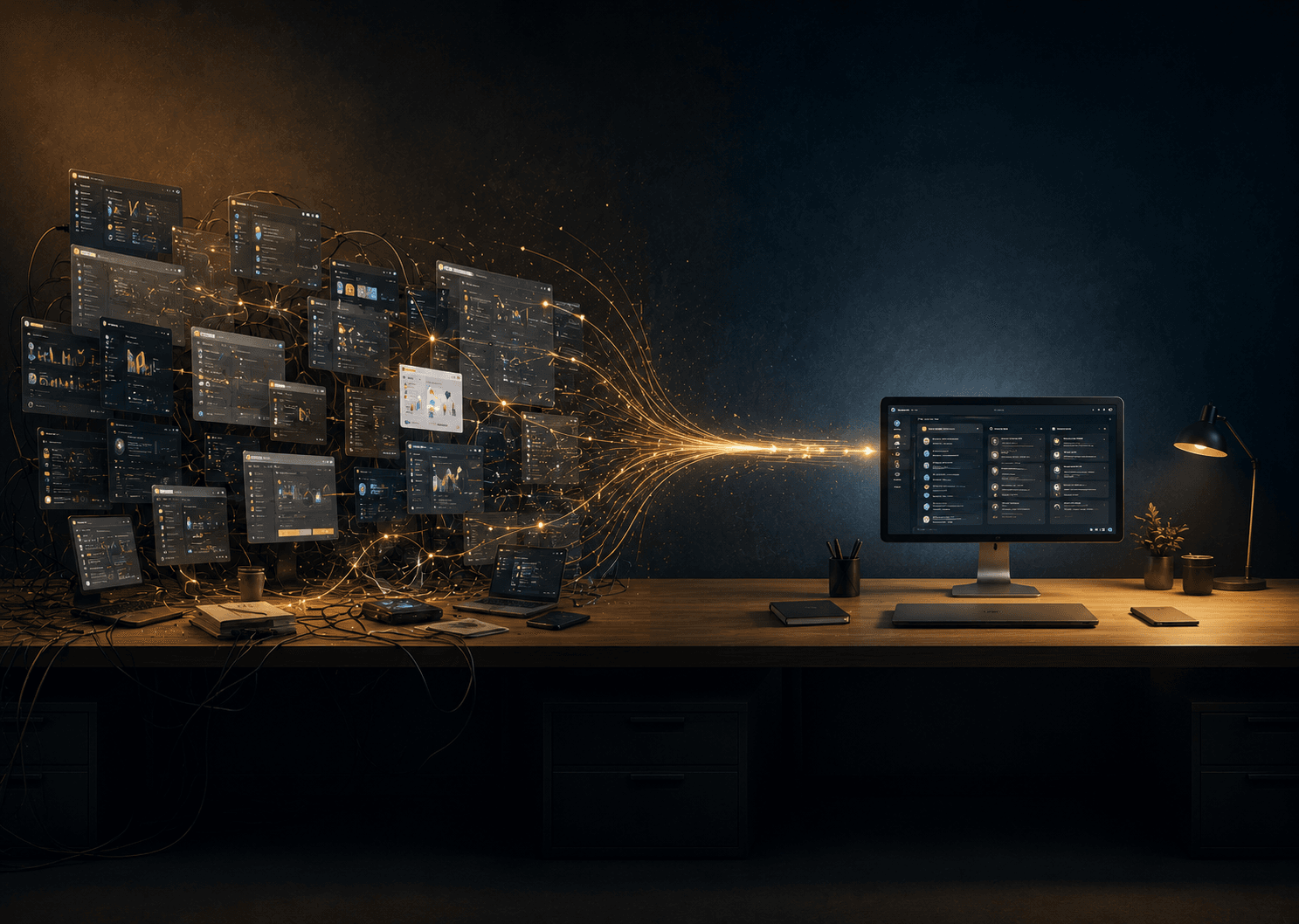
There is a quiet pattern inside most founder-led businesses running AI. The work runs through one person. They built the setups, they know which automation does what, they can tell you what the AI produced last week because it lives in their head and their chat history. The rest of the team sees results landing and cannot see the work behind them. They cannot catch a bad output before it ships, and they cannot keep any of it running if that one person is out. It feels like being ahead. It is closer to a dependency with one name on it.

Can my team see what the AI is doing, or is it a black box only I touch

If only one person can answer what the AI did, the AI is a black box to everyone else, and that is an operating problem, not just a feeling. A black box is a system with visible inputs and outputs and opaque internals, and the lack of transparency reduces trust in its outputs. The point worth catching is that the market answers this with model explainability, the science of showing how a model reasoned. A founder does not need the model explained. They need the work shown. Whether your teammates can see what the AI did is a separate question from how the model arrived at it, and it is the one that decides whether the team trusts the output enough to use it.

86% of organizations have no visibility into how data flows to and from their AI tools. You cannot secure, catch, or trust what you cannot see.
Reco, 2025 State of Shadow AI Report, 2025

How do I show the team the AI is pulling its weight without calling a meeting

You show it by making the work self-evident, not by narrating it. If the only record of what the AI did is in your head, then proving it pulled its weight means calling a meeting and recounting it, which is itself a tax on your time. Visibility you have to narrate is not visibility. The work has to be visible on its own, in a place the team already looks, so a teammate can see what ran, what it touched, and what came out without asking you. This matters more than it sounds, because most AI use is already happening out of sight: 75% of knowledge workers use AI tools, and 46% say they would not stop even if told to. The usage is real. The visibility is missing.

Who owns the AI work when something it did goes wrong

Someone on the team owns it, by name, and the record shows who. The most common failure mode is that when an AI-produced output goes wrong, nobody is sure who was responsible, because nobody could see the work in the first place. That is exactly the fear workers name: 38% say no accountability for AI mistakes is their top concern about AI at work. Ownership is not a policy you announce. It is a property of visible work. When the team can see which person ran what and what the AI did inside it, accountability is obvious and a mistake is catchable before it becomes a customer’s problem. When the work is invisible, ownership is a guess.

How do I stop the AI from being a thing only one person understands

You move the AI work out of one person’s head and into a shared view the whole team reads. The one-person black box is the AI version of the founder bottleneck. The know-how sits with whoever built the setups, so the team cannot catch its mistakes, cannot own its outputs, and cannot keep it running if that person steps away. The scale of the hidden surface is the warning: the smallest firms average hundreds of unsanctioned AI tools per thousand employees, almost none of them visible to the team as a whole. The fix is not more discipline from the one person. It is making the work visible by default, so understanding it is no longer a specialty.

75% of knowledge workers already use AI tools, and 46% would not stop if asked. The usage is not the gap. The visibility is.
Auvik, Why Visibility Is the #1 IT Priority in 2025

Why does a team trust AI work it can see and distrust work it cannot

Because trust tracks visibility, and it collapses fastest exactly where the work is hardest to watch. This is the load-bearing idea: visibility is the trust mechanism. A team trusts AI work it can see, and it distrusts AI work it cannot. The cleanest way to say the reframe is this. Transparency for a regulator answers a question an auditor asks, can this be verified. Visibility for a team answers the question the people doing the work actually have, can we see it. Get the second one right and trust follows, because the work is no longer something the team is asked to take on faith. It is something they can read.

What within-team visibility looks like when it is built in

Any real answer here has to clear one bar: the work has to be visible to the whole team without the person who set it up in the room. That is the bar Works was built to clear. A few specifics, not a feature list:

  • Pain: AI work that only one person can see, with no way for the team to catch or own it.
    How Works does it: every workflow run, every agent action, and every outcome is logged in a cross-workspace activity log the whole team reads, filterable by time, area, and person.
    Gain: the work is self-evident, so no one has to narrate it.

  • Pain: nobody knows who owns an AI output when it goes wrong.
    How Works does it: each run carries which agent or person ran it, what tools it touched, and what it produced, versioned and retrievable.
    Gain: accountability is a property of the record, not a guess.

  • Pain: the setup breaks the week the operator is out.
    How Works does it: the work lives in the shared workspace, not one person’s chat history.
    Gain: the team can keep it running.

This is the lighter end of what Works does, on purpose. The point of this piece is the trust mechanism, not the product. Works is named here because it is one place the mechanism is built in, with plans starting at a price a founder-led business can carry rather than an enterprise install.

Get within-team visibility for your AI work. Get early access. If you want to see what proof-of-work looks like first, ask us for the written example.

The AI nobody but you can see was never evidence you are ahead. It is the thing that breaks the week you are out. Make the work visible to the team, and you find out whether you built an asset or a dependency.

Common Questions

Is AI transparency the same as within-team visibility?

No. AI transparency usually means model explainability, showing how a model reasoned, or a compliance audit for a regulator. Within-team visibility is plainer and more useful day to day: can the people doing the work see what the AI did and who owns it. A founder rarely needs the model explained. They need the work shown. The deeper version of the performance question, whether the AI is actually working, is covered in the honest AI audit.

Does my team need the AI model explained to trust it?

No. Within-team trust in AI work tracks visibility, not model internals: a plain-English record of what ran, what it touched, and what it produced does more than any technical explanation of how the model reasoned. Research finds teams withhold trust from AI outputs they cannot inspect, regardless of how the model is explained. The artifact that makes this concrete is covered in the AI action log.

What is the difference between an AI audit and within-team visibility?

An audit is a point-in-time verification, often for someone outside the team. Within-team visibility is continuous and is for the people inside the work. One answers can an outsider verify this; the other answers can we see it as we go. They are complementary. The named version of the distrust that visibility resolves is covered in the quiet suspicion.

How do I know if only one person can see the AI work?

The test is simple: ask another teammate to describe what the AI did last week without asking you first. If they cannot, the work is effectively invisible to them. A shared activity log answers that question by default, so the whole team reads the same record rather than relying on one person to relay it.

What happens to the team’s AI setup when the person who built it is out?

Without shared visibility, the setup stalls because the know-how is a personal dependency, not a team asset. Firms average hundreds of unsanctioned AI tools per thousand employees, almost none of them documented for handoff. A shared workspace means any teammate can pick up the work from the record rather than starting from nothing.

Get Started With AI

Are You Ready to Make AI Work for You?

Simplify your AI journey with solutions that integrate seamlessly, empower your teams, and deliver real results. Jyn turns complexity into a clear path to success.

See AI for Real Business Impact in Action →

ai that powers your team 226d8ee5db

Can Your Team See What Your AI Actually Did

Why the AI only one person can see is a risk, not an edge, and what makes the work something your whole team can trust.

Technology
By Mark Choudhari · Jun 3, 2026 · 5 min read

The AI only you can see is not an asset. It is a single point of failure.
Made with Works

TL;DR

Within-team visibility is a shared, plain-English view of what your AI did and who owns it. It is the trust mechanism for AI work, and it is a different thing from model explainability or a compliance audit. A team trusts AI work it can see and distrusts work it cannot. JynAI built Works, an AI Business OS, so the whole team can see the work, not just the person who set it up.

In this article

There is a quiet pattern inside most founder-led businesses running AI. The work runs through one person. They built the setups, they know which automation does what, they can tell you what the AI produced last week because it lives in their head and their chat history. The rest of the team sees results landing and cannot see the work behind them. They cannot catch a bad output before it ships, and they cannot keep any of it running if that one person is out. It feels like being ahead. It is closer to a dependency with one name on it.

Can my team see what the AI is doing, or is it a black box only I touch

If only one person can answer what the AI did, the AI is a black box to everyone else, and that is an operating problem, not just a feeling. A black box is a system with visible inputs and outputs and opaque internals, and the lack of transparency reduces trust in its outputs. The point worth catching is that the market answers this with model explainability, the science of showing how a model reasoned. A founder does not need the model explained. They need the work shown. Whether your teammates can see what the AI did is a separate question from how the model arrived at it, and it is the one that decides whether the team trusts the output enough to use it.

86% of organizations have no visibility into how data flows to and from their AI tools. You cannot secure, catch, or trust what you cannot see.
Reco, 2025 State of Shadow AI Report, 2025

How do I show the team the AI is pulling its weight without calling a meeting

You show it by making the work self-evident, not by narrating it. If the only record of what the AI did is in your head, then proving it pulled its weight means calling a meeting and recounting it, which is itself a tax on your time. Visibility you have to narrate is not visibility. The work has to be visible on its own, in a place the team already looks, so a teammate can see what ran, what it touched, and what came out without asking you. This matters more than it sounds, because most AI use is already happening out of sight: 75% of knowledge workers use AI tools, and 46% say they would not stop even if told to. The usage is real. The visibility is missing.

Who owns the AI work when something it did goes wrong

Someone on the team owns it, by name, and the record shows who. The most common failure mode is that when an AI-produced output goes wrong, nobody is sure who was responsible, because nobody could see the work in the first place. That is exactly the fear workers name: 38% say no accountability for AI mistakes is their top concern about AI at work. Ownership is not a policy you announce. It is a property of visible work. When the team can see which person ran what and what the AI did inside it, accountability is obvious and a mistake is catchable before it becomes a customer’s problem. When the work is invisible, ownership is a guess.

How do I stop the AI from being a thing only one person understands

You move the AI work out of one person’s head and into a shared view the whole team reads. The one-person black box is the AI version of the founder bottleneck. The know-how sits with whoever built the setups, so the team cannot catch its mistakes, cannot own its outputs, and cannot keep it running if that person steps away. The scale of the hidden surface is the warning: the smallest firms average hundreds of unsanctioned AI tools per thousand employees, almost none of them visible to the team as a whole. The fix is not more discipline from the one person. It is making the work visible by default, so understanding it is no longer a specialty.

75% of knowledge workers already use AI tools, and 46% would not stop if asked. The usage is not the gap. The visibility is.
Auvik, Why Visibility Is the #1 IT Priority in 2025

Why does a team trust AI work it can see and distrust work it cannot

Because trust tracks visibility, and it collapses fastest exactly where the work is hardest to watch. This is the load-bearing idea: visibility is the trust mechanism. A team trusts AI work it can see, and it distrusts AI work it cannot. The cleanest way to say the reframe is this. Transparency for a regulator answers a question an auditor asks, can this be verified. Visibility for a team answers the question the people doing the work actually have, can we see it. Get the second one right and trust follows, because the work is no longer something the team is asked to take on faith. It is something they can read.

What within-team visibility looks like when it is built in

Any real answer here has to clear one bar: the work has to be visible to the whole team without the person who set it up in the room. That is the bar Works was built to clear. A few specifics, not a feature list:

  • Pain: AI work that only one person can see, with no way for the team to catch or own it.
    How Works does it: every workflow run, every agent action, and every outcome is logged in a cross-workspace activity log the whole team reads, filterable by time, area, and person.
    Gain: the work is self-evident, so no one has to narrate it.

  • Pain: nobody knows who owns an AI output when it goes wrong.
    How Works does it: each run carries which agent or person ran it, what tools it touched, and what it produced, versioned and retrievable.
    Gain: accountability is a property of the record, not a guess.

  • Pain: the setup breaks the week the operator is out.
    How Works does it: the work lives in the shared workspace, not one person’s chat history.
    Gain: the team can keep it running.

This is the lighter end of what Works does, on purpose. The point of this piece is the trust mechanism, not the product. Works is named here because it is one place the mechanism is built in, with plans starting at a price a founder-led business can carry rather than an enterprise install.

Get within-team visibility for your AI work. Get early access. If you want to see what proof-of-work looks like first, ask us for the written example.

The AI nobody but you can see was never evidence you are ahead. It is the thing that breaks the week you are out. Make the work visible to the team, and you find out whether you built an asset or a dependency.

Common Questions

Is AI transparency the same as within-team visibility?

No. AI transparency usually means model explainability, showing how a model reasoned, or a compliance audit for a regulator. Within-team visibility is plainer and more useful day to day: can the people doing the work see what the AI did and who owns it. A founder rarely needs the model explained. They need the work shown. The deeper version of the performance question, whether the AI is actually working, is covered in the honest AI audit.

Does my team need the AI model explained to trust it?

No. Within-team trust in AI work tracks visibility, not model internals: a plain-English record of what ran, what it touched, and what it produced does more than any technical explanation of how the model reasoned. Research finds teams withhold trust from AI outputs they cannot inspect, regardless of how the model is explained. The artifact that makes this concrete is covered in the AI action log.

What is the difference between an AI audit and within-team visibility?

An audit is a point-in-time verification, often for someone outside the team. Within-team visibility is continuous and is for the people inside the work. One answers can an outsider verify this; the other answers can we see it as we go. They are complementary. The named version of the distrust that visibility resolves is covered in the quiet suspicion.

How do I know if only one person can see the AI work?

The test is simple: ask another teammate to describe what the AI did last week without asking you first. If they cannot, the work is effectively invisible to them. A shared activity log answers that question by default, so the whole team reads the same record rather than relying on one person to relay it.

What happens to the team’s AI setup when the person who built it is out?

Without shared visibility, the setup stalls because the know-how is a personal dependency, not a team asset. Firms average hundreds of unsanctioned AI tools per thousand employees, almost none of them documented for handoff. A shared workspace means any teammate can pick up the work from the record rather than starting from nothing.

Get Started With AI

Are You Ready to Make AI Work for You?

Simplify your AI journey with solutions that integrate seamlessly, empower your teams, and deliver real results. Jyn turns complexity into a clear path to success.


See AI for Real Business Impact in Action →

ai that powers your team 226d8ee5db