Mar 17, 2026


Are you adapting fast enough to keep up with constant market changes? AI economic growth is rewarding businesses that act quickly. Scroll down to learn how businesses use AI for growth.
Not long ago, many businesses relied on slow processes, manual analysis, and instinct to guide decisions. Now, artificial intelligence is shaping AI economic growth by changing how companies operate and how economies expand. Organizations process large volumes of information in minutes, respond to market shifts faster, and run operations with greater precision, reshaping competition and global economic patterns and demonstrating how AI drives economic growth.
Across sectors, companies use intelligent systems to improve productivity and speed up routine work. Manufacturing firms automate production, financial institutions detect fraud through pattern analysis, and healthcare providers use data to support diagnosis. Marketing teams understand customer behavior, personalize campaigns, and measure performance more accurately, helping businesses move ideas to market faster through machine learning in business and stronger automation and economic productivity.
Companies are also rethinking their approach through AI in business strategy. They test products quickly, predict demand, and adapt services to changing preferences. Marketing teams now rely on data insights instead of broad assumptions. Platforms such as JynAI Works reflect this shift, enabling AI business transformation by allowing marketers to request campaigns, generate prospects, draft outreach, schedule communication, and track performance in far less time.
These changes affect employment and economic growth. Some routine tasks decline as automation takes over repetitive work, while new roles emerge in data analysis, digital strategy, and technology development. Countries and companies that invest in skills and digital infrastructure tend to adapt faster and benefit from AI driven business growth and stronger economic outcomes.
Trade and supply chains are evolving as well. Businesses forecast demand more accurately, manage inventory with predictive insights, and track goods across global networks in real time, reducing delays and supporting more stable international trade shaped by AI impact on global business.
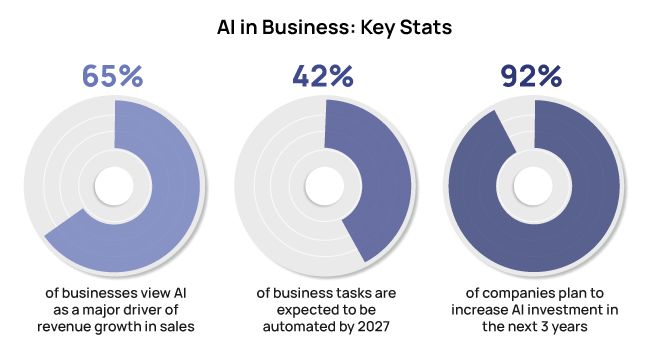
Artificial intelligence is influencing how industries operate, compete, and serve customers. Some sectors already use AI at scale, while others are still expanding early use cases. As AI adoption in enterprises grows, these industries are expected to see noticeable shifts in productivity, cost structure, and service delivery.
Here are some industries expected to see significant impact from AI:
Healthcare: AI supports faster drug discovery through predictive modeling and improves diagnostic accuracy using medical imaging analysis. Hospitals apply AI in patient scheduling, resource allocation, and operational planning. Telemedicine platforms also use AI for symptom assessment and triage, supported by AI powered decision making, which helps clinicians respond faster and expands access to care.
Financial Services: Banks and financial institutions apply AI to automate trading strategies, detect fraud using anomaly detection algorithms, and power customer service chatbots. Many lenders rely on AI-based credit scoring models to refine lending decisions. Investment firms also use machine learning to support portfolio analysis and risk management, strengthened by AI analytics for business growth.
Retail and E-commerce: Retailers use AI recommendation engines to personalize product suggestions and improve customer engagement. Predictive analytics helps manage inventory and forecast demand. AI also supports dynamic pricing, visual product search, automated customer service, and supply-chain forecasting, contributing to AI business innovation.
Manufacturing: AI-enabled robotics and predictive maintenance tools help manufacturers reduce downtime and improve production efficiency. Companies monitor equipment health with machine learning models that identify potential failures early. AI systems also assist with automated quality inspection and production optimization using intelligent automation in enterprises.
Media and Telecom: Media companies apply AI in content creation, audience personalization, and content distribution. Telecom providers use AI to optimize network performance, predict equipment failures, and automate customer service. Generative AI is also influencing search, advertising models, and digital content monetization as part of AI powered digital transformation.
Technology: AI drives significant investment across the technology sector. AI computing platforms, advanced machine learning models, and multi-agent systems support software development, cybersecurity monitoring, and enterprise workflow automation, reflecting ongoing artificial intelligence market trends.
Energy: Energy companies use AI to forecast demand, optimize power generation, and manage grid operations. Utilities also apply AI to support sustainability goals and improve operational efficiency. At the same time, the expansion of AI data centers increases electricity demand, prompting new investment in energy capacity and efficiency solutions tied to the AI innovation ecosystem.
[Source]
Artificial intelligence adoption brings clear opportunities, but it also introduces operational, ethical, and strategic hurdles. Businesses often tell us the benefits are clear, yet the path to responsible and effective use needs careful planning. Addressing these issues early helps organizations adopt AI with confidence and stability.
Let’s explore the main challenges and the solutions that address them:
AI systems rely heavily on data. That creates concerns around data collection, consent, transparency, and misuse. Without strong safeguards, organizations risk losing user trust and facing reputational damage.
Build a structured data governance program:
This approach helps protect user data while keeping AI systems accountable.
Automation can shift job roles and reduce demand for certain tasks. Employees may worry about job security or lack the skills needed for AI-driven workflows.
Invest in workforce development:
Organizations that support employee transition often see stronger adoption and internal support for AI initiatives.
AI regulations continue to evolve across many regions. Companies must track these changes to avoid compliance risks and legal exposure.
Adopt proactive compliance practices:
A proactive compliance strategy reduces risk and builds credibility with regulators and customers.
Deploying AI systems often requires infrastructure upgrades, specialized talent, and integration with existing workflows. These factors can strain budgets, especially for smaller businesses.
Adopt a phased implementation strategy:
A staged rollout helps control costs while demonstrating measurable value.
As AI becomes part of daily operations, organizations must consider energy usage, system maintenance, and long-term economic viability.
Sustainable AI strategies help organizations manage long-term operational impact while supporting environmental and financial responsibility.
Many organizations are still asking what actually makes AI work in real business environments. Tools alone rarely deliver results unless companies apply the right strategies. Platforms like JynAI Works show that when AI connects directly to real business tasks, teams can reduce execution time and scale operations faster. The question then becomes how organizations structure their approach so AI delivers measurable impact.
Here are strategic approaches that help businesses translate AI capability into real economic and operational outcomes:
Organizations that invest consistently in AI research and development build stronger innovation pipelines. Internal R&D programs, experimentation with new models, and partnerships with research institutions help companies move from isolated AI experiments to scalable solutions that support long-term growth.
Collaboration between companies, academic institutions, and technology providers speeds up the development of AI applications. Partnerships allow teams to combine expertise, share resources, and build solutions tailored to industry challenges. This approach often shortens development cycles and improves the quality of AI deployments.
Responsible development helps organizations build trust in AI-driven systems. Companies can introduce internal policies that address transparency, fairness, and accountability. Ethical frameworks guide how AI models are trained, deployed, and monitored, which reduces risks tied to bias, misuse, or regulatory issues.
AI delivers results when employees understand how to work alongside intelligent systems. Organizations can support this shift through training programs, technical skill development, and continuous learning initiatives. Upskilling helps employees adapt to new roles while enabling teams to use AI tools effectively.
Data quality and security directly affect AI performance. Businesses need structured policies to manage how data is collected, stored, and used. Clear governance practices protect sensitive information, support compliance requirements, and help AI systems operate reliably across different business functions.
AI will continue to shape business strategy and economic growth in the coming years. One major trend is AI democratization, which will make AI tools easier and cheaper to access. As more small and medium-sized businesses adopt AI, productivity can increase across industries. Companies will automate routine tasks, analyze market data faster, and make better decisions. This wider use of AI can raise competition, encourage innovation, and contribute to stronger economic growth by allowing more firms to participate in the digital economy.
Another trend is stronger human–AI collaboration. Businesses will rely on AI to process large volumes of data, identify patterns, and support decision-making. At the same time, employees will focus on creative thinking, strategy, and problem solving. This partnership can improve product development, marketing strategies, and operational efficiency. As organizations combine human judgment with AI analysis, they can improve performance and respond faster to market changes.
AI will also drive new business models by integrating with emerging technologies such as the Internet of Things, blockchain, and quantum computing. These combinations can improve supply chain transparency, enable smarter connected devices, and expand data-driven services. As industries adopt these systems, they can create new markets, attract investment, and support digital transformation across the global economy.
Another growing focus is sustainable AI. Businesses are starting to use AI to reduce energy consumption, manage resources efficiently, and track environmental impact. These practices can lower operational costs and support long-term economic stability. Companies that invest in sustainable technologies may also attract customers, investors, and partners who value responsible business practices. Together, these trends show that AI will remain a strong driver of productivity, innovation, and economic expansion.
To turn these trends into practical outcomes, businesses need systems that work together, not in isolation. That’s where JynAI comes in. JynAI connects your CRM, HR systems, financial tools, and other platforms into one unified layer, so your data flows across the organization. Instead of switching between tools, you can streamline workflows, remove silos, and get more value from the systems you already use. If you’re looking to align AI adoption with real operational impact, get in touch with JynAI to see how a connected approach can support your next phase of growth.
[Source]
AI tools automate routine tasks, analyze large data sets, and support employees with insights. Teams spend less time on manual work and more time on strategy and innovation. This change increases efficiency and helps companies produce more with the same resources.
Businesses apply AI in areas such as marketing analytics, customer service chatbots, demand forecasting, and product recommendations. These tools help companies understand customer behavior and adjust strategies quickly. The result is better customer engagement and higher revenue potential.
AI contributes to economic growth by improving efficiency in sectors like manufacturing, logistics, finance, and healthcare. It reduces operational errors and speeds up production and service delivery. These improvements increase productivity at both company and national levels.
AI helps companies make faster decisions based on real-time data and predictive analysis. It also improves customer experience through personalization and automated support. Businesses that use AI often identify market opportunities earlier than competitors.
AI changes how organizations operate by automating processes and improving data-driven decision-making. Countries investing in AI research and infrastructure often gain advantages in innovation and productivity. This shift influences global trade, labor demand, and economic competitiveness.
Industries that generate large volumes of data benefit strongly from AI. Healthcare uses AI for diagnosis support, finance for fraud detection, and retail for personalized recommendations. Manufacturing and logistics also use AI to optimize production and supply chains.
Simplify your AI journey with solutions that integrate seamlessly, empower your teams, and deliver real results. Jyn turns complexity into a clear path to success.