Why the assistant, agent, tool, or platform debate misses the point, and the one question that tells you what you are actually buying.

Why the assistant, agent, tool, or platform debate misses the point, and the one question that tells you what you are actually buying.
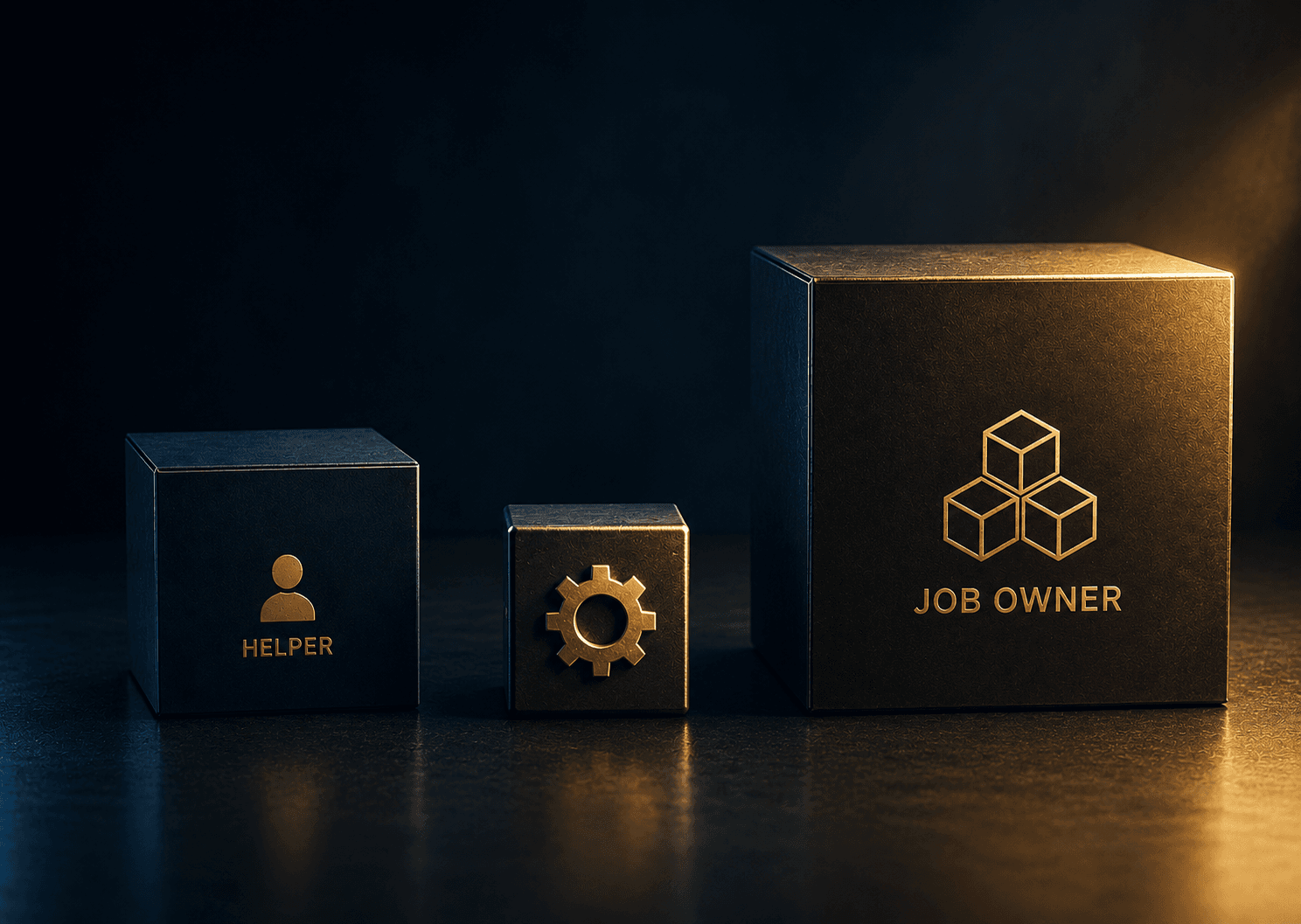
Buyers try to file new AI under a box they already have: assistant, agent, tool, platform. None of those fit a system built to run whole jobs. The useful question is not which label but which altitude. A tool helps with a task; a system owns a job. JynAI calls that altitude an AI Business OS, and the budget line is the tell.
A tool helps with a task. A system owns a job. That is the whole difference, and it is a difference of altitude, not horsepower. A tool speeds a step you were already doing: it drafts the email, summarizes the call, generates the image. A system holds an outcome and runs the work end to end toward it, across the steps and the tools the job touches. The same underlying model can power either one. What separates them is whether you are buying help with a step or ownership of a job.
This distinction is the one the labels keep hiding. Assistant, agent, tool, and platform are all attempts to describe the first altitude with more capability bolted on. None of them names the second. So when a buyer files a job-running system under a task-tool budget line, the expectation is set at the wrong altitude, and the thing underdelivers against a standard it was never built to meet.
It is a system, and the reason the other three labels feel close but wrong is that each names a piece of the altitude below it. An assistant responds to a request. An agent can take an action on its own. A platform is where tools live. A system that runs whole jobs uses all of those as parts, but it is defined by the job it owns, not by any one of them. Reaching for the nearest of the four is the most common way a buyer mis-files what they are looking at.
The cost of mis-filing is not just semantic, because category is where the value concentrates. The research on category creation is direct about it.
Category Kings capture roughly 76 percent of their category’s total market capitalization, and 35 of them took over 70 percent of all value created by venture-backed tech since 2000.
Play Bigger, Time to Market Cap Report
The Play Bigger research is US venture-backed tech from 2000 to 2015, so scope it as that, not as every market. The mechanism, though, travels: category creators win on a different frame, not a better spec sheet.
Category creators do not sell us a better product. They sell us a different one, replacing the buyer’s current point of view rather than improving inside it.
Newsweek, Forget Disruption, Creators Dominate Markets Now (Kevin Maney), 2016
The Newsweek adaptation of the Play Bigger thesis makes the buyer-psychology point plainly: different beats better. Which is exactly why forcing a different altitude into a familiar box is self-defeating.
An agent can take an action; an assistant can only describe one. Ask an assistant to send the follow-up and it drafts the text and hands it back. An agent can actually send it, update the record, and move to the next step, because it has tools and a degree of autonomy the assistant does not. That is a real difference, and it is worth stating plainly rather than blurring.
And here is the turn: that capability is not an identity. A system that runs whole jobs uses agent-style actions as one of its parts, but anchoring its name to “agent” borrows a crowded, enterprise-coded label that is already carrying a heavy cancellation forecast in the analyst coverage. The honest move is to answer the agent question and then climb out of the agent box, because the box is not where a job-running system lives. Naming what something is not, not a chatbot, not an automation wire, not an agent framework, does more to place it correctly than reaching for the nearest crowded label.
You are buying ownership of a job, and the budget line is the tell. A per-seat tool line is the wrong drawer, because that line is sized for help-with-a-task software. The right drawer is an operations line, because what you are buying runs the work, not a step of it. If the thing genuinely goes on the same line as your chat subscriptions, it is a tool. If it belongs next to the functions that run the business, it is a system, and the budget line just told you which altitude you are at.
This is not a hypothetical re-sort. Buyers are moving their budgets toward systems in real time, because AI made connected data the requirement.
Best-of-breed procurement fell to 20.7 percent, the mostly-platform model rose to 65.9 percent, and 41 percent of firms plan to consolidate applications, with AI named the primary driver.
Futurum, on app consolidation and best-of-breed decline, 2026
The Futurum data on the procurement re-sort shows the operations line filling up while the point-tool line empties. Buyer preference backs the same shape: in G2’s buyer-behavior research, 84 percent of software buyers prefer one tool that solves multiple problems, and 78 percent prefer buying complementary products from a vendor they already use, per the platform-versus-point-solution analysis.
The most common mistake is buying a system’s job from a tool’s altitude, then judging the result as if it were a tool. A founder assembles a pile of point tools, each excellent at its step, and expects the pile to add up to a run business. It does not, because no tool in the pile owns the job, and the integration work of making them behave like a system lands back on the founder. The pile is an experiment in systemhood that the buyer is running by hand.
The choice underneath this, the pile of point tools versus a single system that runs the work, is the real decision a founder is making, and it has more than two options. The full set, from assembling tools yourself to renting an external expert to buying a system, is the six-path comparison this pillar lays out in its battlecard of the six alternatives. The point here is narrower: the mistake is not picking the wrong tool. It is shopping at the wrong altitude.
Any honest answer to “what box does this go in” has a bar to clear. It has to own a whole job rather than help with a step, run across the tools you already use, and belong on an operations line rather than a per-seat tool line. Clear that bar and the label stops mattering, because the altitude is unmistakable. Miss it and you have bought another tool to add to the pile.
This is the bar JynAI built Works to clear, and the honest name for the box is a new one: AI-native business management, your AI business manager, with receipts. That is the altitude, a system that owns the job, which is why the AI Business OS is a category rather than a feature. A few of the things that make it a system and not a tool:
The full definition of what an AI Business OS contains, and what it should refuse to do, is a separate treatment; what to look for in one is covered here. The price keeps the category claim honest: the single-operator tier is $49, not an enterprise contract, and it is proven in production, deployed across six teams at Machintel as the live reference customer.
See the new category. Get early access, or explore at jyn.ai. If you want the shorter orientation first, the Process map walks through the altitude question for your own stack.
An AI assistant responds to a request and returns a result, a draft, a summary, or an answer, then waits. An AI agent can take an action on its own across connected tools because it has autonomy the assistant lacks. The practical difference is whether the thing describes work or does it. Neither altitude, however, owns a whole job end to end, which is the layer above both. For where that altitude line sits, see the tool-versus-system breakdown above.
No. A chat assistant is reactive and session-bound; it waits for each prompt and its value ends when the tab closes. An agent can act between prompts, update records, move work forward in connected tools. The meaningful question is not assistant versus agent but task altitude versus job altitude: even an agent that acts is still at the task rung unless it holds the outcome, runs every step, and finishes the job, which is the distinction this piece is about.
A system needs to own an outcome, run across the tools a job touches, and produce a record of what it did. A single tool needs only to do its one step well. That is why systems belong on an operations budget line and tools belong on a per-seat one. The buyer mistake is expecting a pile of tools to behave like a system without anything in the pile owning the job.
You need the higher altitude when the thing you want done is a job, not a step: order to invoice, lead to booked meeting, a function that has to run rather than a task that has to be drafted. If you find yourself being the integration layer between tools, that is the signal you are shopping one altitude too low. The why-now case for this shift covers what changed to make the system altitude reachable for founder-led businesses.
No, because the buyers are re-sorting on their own. Best-of-breed procurement is collapsing toward platforms because AI needs connected data, and analysts are naming new layers above the productivity-tool stack. The new box is forming in the procurement data and the research, not only in vendor copy. Category honesty, naming what a product is not, is a trust move before it is a marketing one.
Keep reading:
Simplify your AI journey with solutions that integrate seamlessly, empower your teams, and deliver real results. Jyn turns complexity into a clear path to success.