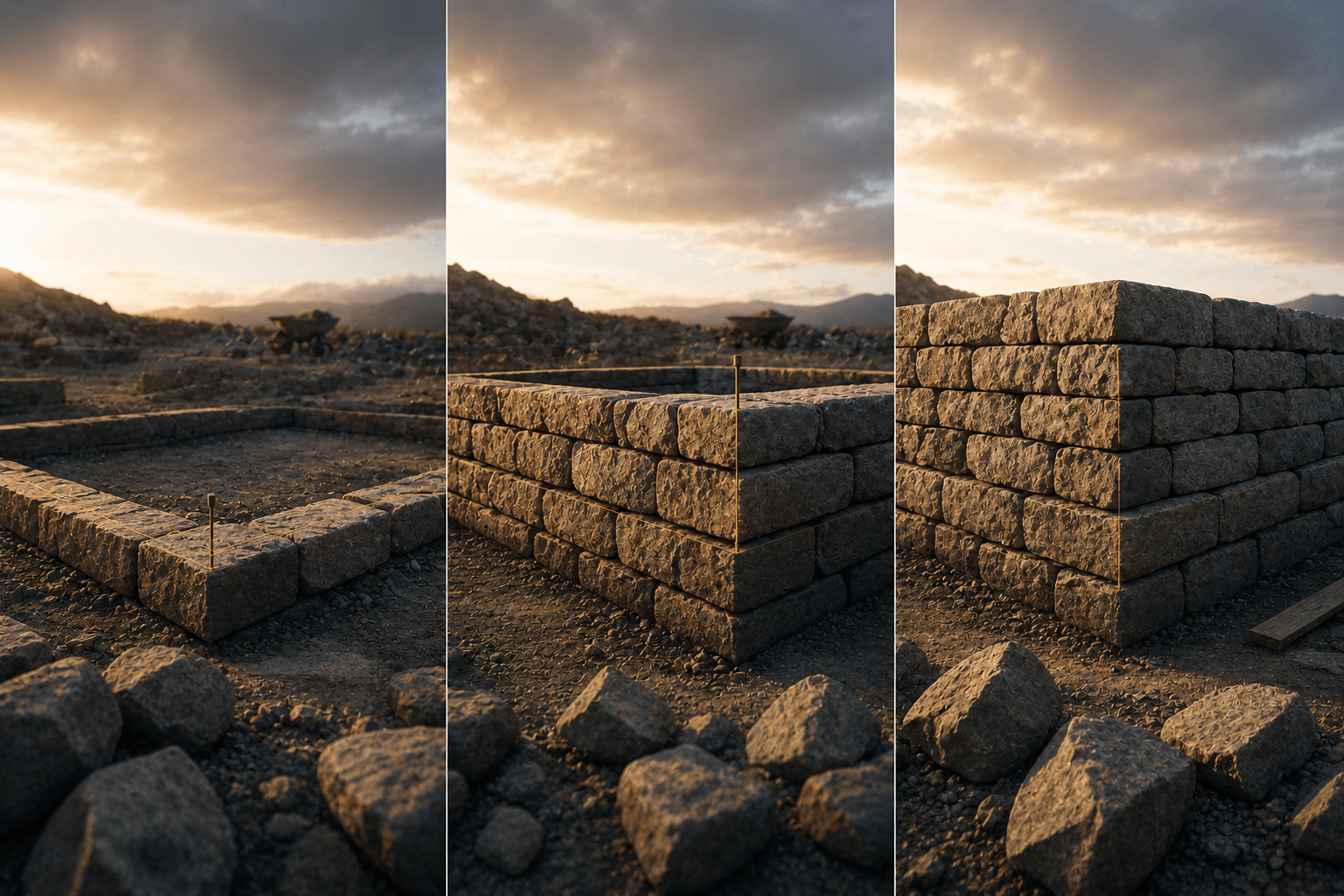
Each tool ends at its own edge. The work falls in the gap, and you are the one carrying it across.

Each tool ends at its own edge. The work falls in the gap, and you are the one carrying it across.
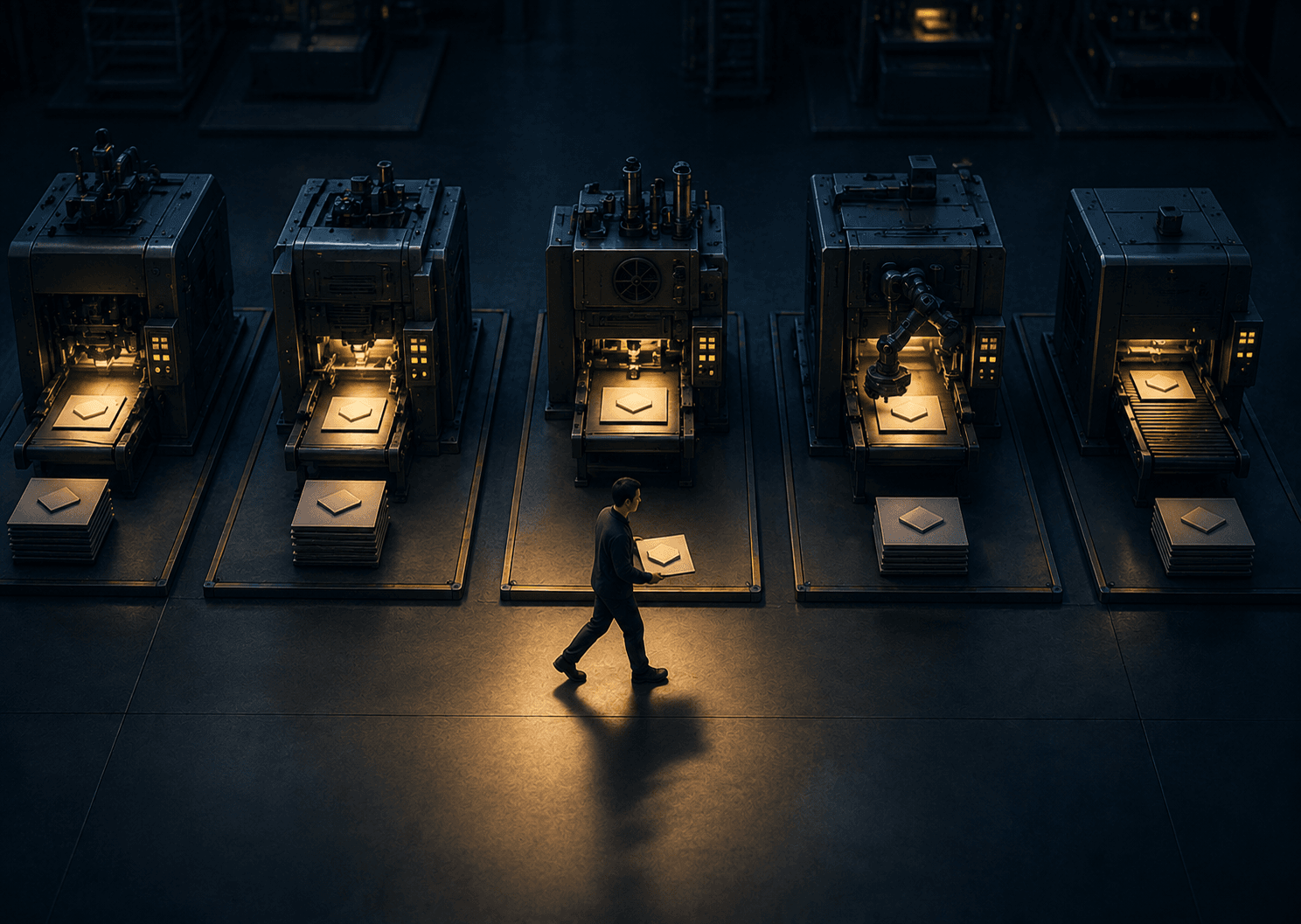
Five AI tools doing five tasks still leave nothing actually running, because each tool ends at its own edge and no one owns the handoffs between them. The work falls into the gap between edges, and the founder becomes the human router. A stack of best-in-class task tools is a collection of moments; a process is the connected thing between them, and the connection is what no point tool sells.
Because five tools doing five tasks is five finished tasks, not one running process. Each tool is excellent at its one task and ends at its own edge, and nothing owns the space between the edges. So the work gets handed from tool to tool by a person, and the moment that person stops carrying it, the work stops. Five tools, five tasks, zero process. The stack is not too small. It is missing the connection that would make it a process.
This is the quiet truth underneath tool fatigue. Adding a sharper tool to each task does not add up to a business that runs, because the thing that would make it run, the handoff between the tasks, is not a task, and no task tool sells it.
Because the handoff is where the tools were never designed to meet. Each tool owns its own task and its own data, and the connection between them is a seam someone has to build and maintain by hand. When an interface changes, a field renames, or an output format shifts, the seam tears, and the work falls through.
The sprawl this happens inside is real and now well documented. In one survey of more than a thousand workers, 46.5 percent bounce between two or more AI tools to finish a single task, 44.8 percent had abandoned AI tools they adopted within the past year, and 77.5 percent would feel indifferent or relieved if half their AI tools were removed. That last figure is the tell: people are not asking for the sixth tool, they are quietly hoping someone takes five away.
77.5 percent of workers would feel indifferent or relieved if half their AI tools were removed.
ClickUp, AI Sprawl Survey, 2025
And the sprawl predates AI, which is why stacking AI on top of it breaks so reliably. Even on a pre-AI baseline, knowledge workers switched between about 13 apps roughly 30 times a day, with a quarter saying the overload made them less efficient. AI did not create the fragmentation. It added more edges to a stack that was already mostly edges.
Picture the work as a relay. The research tool finishes and stops at its edge. The drafting tool starts, finishes, stops at its edge. The sequencer starts, finishes, stops. Between every pair of stops there is a gap, and the baton, the actual work, lives in the gaps, not on the stops. The tools are the runners. Nobody bought the track.
That gap is where the founder lives. You are the one copying the output from one tool into the next, reconciling the formats, remembering which step comes after which, noticing when something stalled. The work runs on your attention, which means it does not really run, it waits for you. A faster task tool added to a broken handoff makes the pile-up arrive sooner, not the job get done.
The supply side guarantees the gaps multiply. Depending on how you count, there are somewhere from around 5,000 to more than 70,000 AI tools available, and most arrive outside any plan, with the average enterprise already running about 23 AI tools, 45 percent of them adopted outside IT. Every new tool is another edge, and every edge is another gap for the work to fall into.
Because stitching connects the tools, it does not own the job. A wired-together stack moves data across the seams as long as the seams hold, but nobody is responsible for the outcome, only for the wiring. So the experiments that get built tend to die quietly: in the field, useful one-off automations never compound into anything that runs the business, because each one ends where the next is supposed to begin and no one owns the begin.
Edge experiments stay edge experiments. Useful one-off automations rarely compound into anything that runs the business.
Board of Innovation, on Gartner data, 2025
The difference is ownership. Wiring keeps the tools talking. It does not catch the work when a seam tears, does not know the goal of the whole job, does not finish what stalled. The gaps come back the moment a tool changes, and the founder is back to being the router with a maintenance bill attached.
Connected tools pass data between separate owners; an integrated system has one owner for the whole job. Connection is plumbing, the pipes between five tools that each still own only their own task. Integration is altitude: one thing that knows the goal, runs every step, hands off between them itself, and finishes the job, with the tools as instruments underneath it rather than five separate destinations.
This is the Drafts to Tasks to Outcomes altitude reframe applied to the stack. Every tool you own lives at the task rung, finishing one bounded action; the job lives a rung up, where the whole process runs end to end. The same picture stands up as the Three-Layer Pyramid: a wall of task tools at the middle tier, and the top tier, where they would combine into an outcome, sitting empty. A better task tool is still a task tool. The missing piece is not a sharper edge. It is the layer that owns the space between edges.
Right now, you do. The founder is the integration layer the stack does not include, holding the process together with attention and memory. That is the most expensive seat in the company doing the cheapest connective work, and it is the reason the business cannot run the job without you in the middle of it.
There are two ways founders try to get out of that seat, and one bridge worth naming. The first is best-of-breed: buy a sharper tool for each task. But better stops still leave the gaps between them, so a sharper edge does not fill the gap. The second is to wire the stack together on an automation platform, which buys wiring, not an owner, and breaks when an interface changes. Whether that path is worth taking at all is its own decision, laid out in the six alternatives. Both roads end at the same question: who owns the whole job, not the parts.
If the missing piece is an owner for the handoffs, the thing to look for is not a sixth tool but one system that runs the whole job across the tools you already have. A real answer to that has to clear a clear bar: reach into the tools you already use rather than replace them; own the handoffs so the work does not fall into the gaps; and run the process end to end so it finishes without you carrying the baton.
JynAI built Works, an AI Business OS, to clear exactly that bar. Here is the fit, plainly:
Pain: the work falls into the gap between five tools.
Works Across Your Stack: reaches about 3,000 apps through native integrations and Pipedream, and your existing Make and n8n automations import in, so the tools you already use share one tool graph instead of five separate edges.
Gain: one connected system, not a stack you keep stitching.
Pain: you are the human router carrying the work between tools.
Work That Actually Ships: runs the process across those tools in one pass, Strategy to plan, Action to execute, Automation to run hands-free, owning the handoffs between steps.
Gain: the job runs first touch to done without you in the middle.
Pain: every new tool is another seam to maintain.
System: absorbs new models and connectors as they ship, inside the setup you already have, so capability grows without adding another edge to manage.
Gain: the stack gets simpler as it gets stronger.
The price proof is what makes this honest for a founder-led business: the full capability set unlocks at the $49 Pro tier, not a six-figure integration project. And the first-party version is plain, the team ran their own job as one process instead of a tool per task and stopped being the router.
Stop stacking tools. Get the process. Get early access. Or get the process map that shows where the work is falling between your tools first.
The test to carry away is the simplest one there is. Count your AI tools, then ask who carries the work between them. If the answer is you, you do not have a process yet, you have a stack. Five tools, five tasks, zero process. The handoff is the product nobody bought.
AI automations break at handoffs because each tool owns only its own task and its own data model, so the bridge between them is a hand-built seam with no owner. Even on a pre-AI baseline, knowledge workers switched between roughly 13 apps about 30 times a day; every one of those transitions is a potential seam. When an interface or field changes, nobody patched the bridge, and the work falls through. The deeper version is the map, not the tools.
Connected tools are five separate owners sharing data through pipes; an integrated system is one owner running the whole job with the tools as instruments underneath it. Connection is plumbing, which breaks when any pipe changes and requires someone to rebuild it. Integration is altitude: the system knows the goal, runs every step, catches failures, and finishes the job, which the plumbing never did.
An automation platform buys you wiring, not an owner: selector-based flows break when an interface changes and you are back to being the router. One system that owns the whole job is the alternative. Which path fits your situation is the decision laid out in the six alternatives.
Right now the founder does, and that is the most expensive seat in the company doing the cheapest connective work. The ClickUp AI sprawl survey found 77.5 percent of workers would feel indifferent or relieved if half their AI tools were removed, a signal that the stack is already too wide to hold. The answer is not a sixth tool but one layer that owns the handoffs so the founder can stop being the connection. The destination, one place instead of five to eight tools, is the consolidation case.
No, because each new tool adds another edge and another gap, not a connection. The thing that resolves the sprawl is not a sharper tool but an owner for the handoffs; the bills the sprawl leaves behind are the subscription graveyard.
Keep reading:
Simplify your AI journey with solutions that integrate seamlessly, empower your teams, and deliver real results. Jyn turns complexity into a clear path to success.