What customer success looks like when you never hired for it

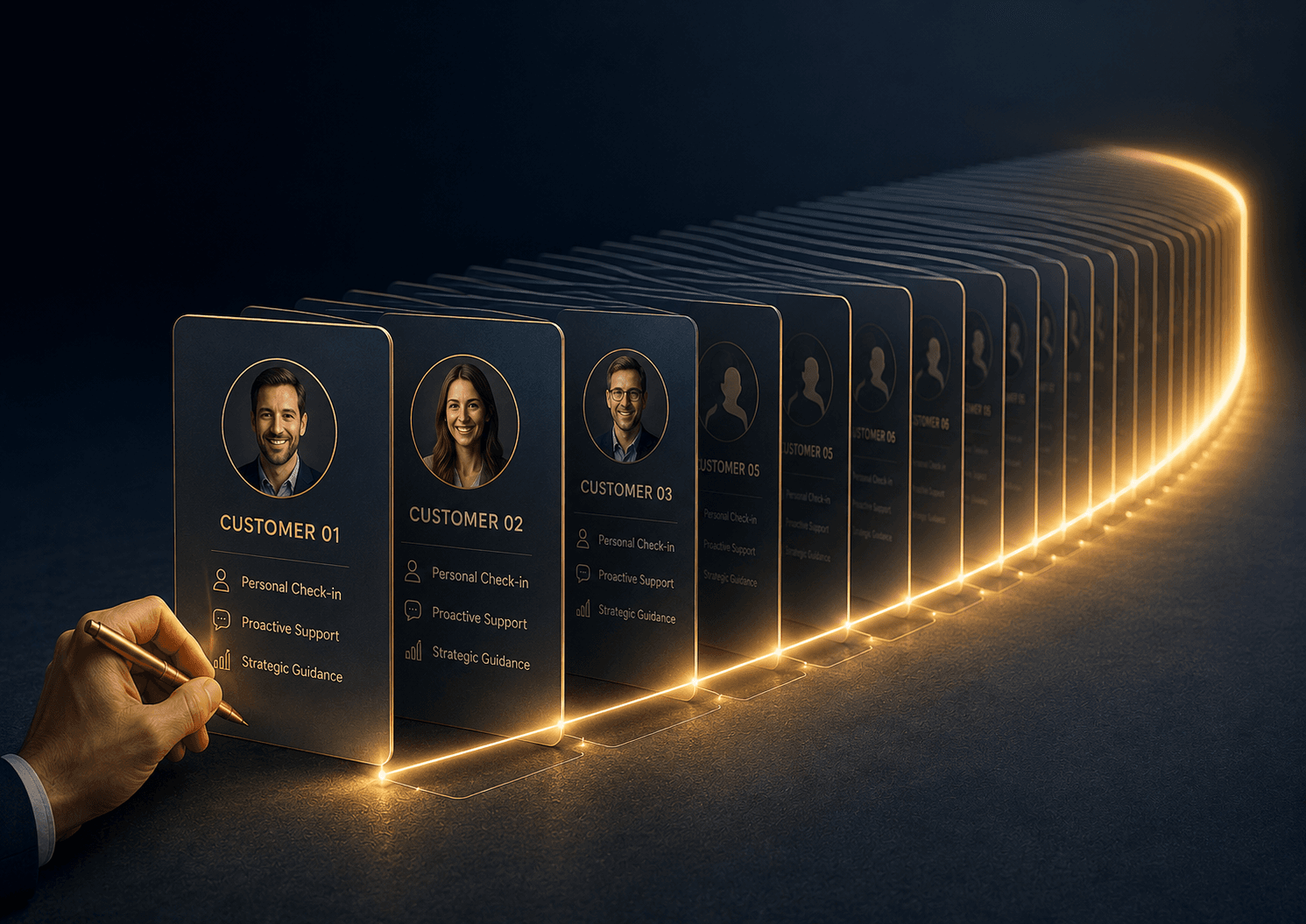
A real cadence across the whole base, including the long tail that used to get a drip and churn in silence, run as a capability instead of a headcount you could not carry.

Technology
By Mark Choudhari · Jun 6, 2026 · 5 min read

The cadence your base needed was never slow. It was unstaffable.
Made with Works

TL;DR

The old answer for a small customer was: too small for a named person, send them a generic drip. That produced silent churn, not coverage. A real cadence across the whole base, onboarding, a mid-lifecycle health check, a genuine pre-renewal conversation, was never a speed problem. It was unstaffable. The capability is attention at scale, not a cheaper support desk.

In this article

Ask which customer-facing function has the clearest case for AI and customer success is near the top, because it is the function most founder-led businesses can name and never staffed. You can picture exactly what it should be: onboarding that lands, a check-in before a problem becomes a churn, a real conversation before a renewal is at risk. You can also picture who gets it today. The handful of accounts big enough to matter get your attention, and everyone else gets the newsletter and a quiet exit. That is the felt problem: the accounts too small for a named person leave without a word, and you can see it happening. JynAI built Works, an AI Business OS, so the cadence runs across the entire base.

What does customer success look like when I never hired a CS person

When you never hired for it, customer success looks like a sorting exercise. The handful of accounts big enough to matter get your attention, or a founder’s attention, and everyone else gets the automated newsletter. That is not a coverage model, it is a triage model, and the people on the wrong side of the triage are the ones who leave without a word.

The reason it works that way is the math, not a lack of care. There is no universal ratio for how many customers one person can keep, and capacity is set from the bottom up by the cadence the customer journey actually requires. A genuine cadence is expensive in people. So the long tail gets the drip, and the founder watches a slow leak they can see and cannot afford to plug. A real cadence across the whole base, the kind that catches a problem before it shows up at renewal, was never a speed problem. It was a headcount problem the model could not justify.

What would giving every customer this level of attention have cost in CS headcount

Under the old cost-per-person math, more than you were ever going to spend. The honest version of the number is a range, not a point: most customer-success managers carry somewhere between $2M and $5M in ARR and ten to five hundred accounts, and the lighter the touch, the more accounts one person can hold. The trouble is that a real cadence is the opposite of a light touch.

Most CSMs carry between $2M and $5M in ARR and ten to five hundred accounts, and the lighter the touch, the more accounts one person can hold.
Tomasz Tunguz, Theory Ventures, 2026

The account-coverage ratio is workload-driven, not a fixed seat count, and proactive customer success degrades past a threshold once a person is carrying too many accounts to run the cadence without automation. So covering two hundred customers with a genuine cadence did not mean asking your people to work faster. It meant hiring more of them, which is exactly the bill a founder-led business cannot write. The operational model for scaling customer-success coverage across a growing base was built for companies with the headcount to staff it. The founder had the same problem and none of the budget. That is the function gap: a function you can name, a cadence you can picture, and no headcount that math allows you to carry.

Could I give every customer the attention that used to require a CS team

Yes, and that is the shift worth understanding, because it is a capability, not a faster version of the old triage. This is the Capability, not Efficiency reframe, and a customer-success cadence across two hundred customers where thirty was the ceiling sits squarely in the Expansion band: not the same work done cheaper, but work the business could not reach before at any speed.

The mechanism is that attention stops being priced per person. When the cadence runs across the whole base at once, onboarding the new customer, checking in mid-lifecycle, opening the renewal conversation before renewal is at risk, the accounts that were too small to cover are no longer too small, because the cost of covering them is no longer a salary divided across a book of accounts. The business did not change. The capability did. The founder who never hired a CS person now runs the CS function across every customer, which is a different thing from running it faster.

Attention at scale, not a cheaper help desk

The easy misread is that this is a support desk with a lower headcount. It is not, and the distinction matters. A help desk waits for the ticket. It is reactive by nature, and it does its best work after the customer has already noticed something is wrong. The cadence is the opposite: it reaches out, on a schedule the customer never sees, across the moments that decide whether they stay.

Read through Drafts to Tasks to Outcomes, the difference is altitude. A faster reply to an inbound question is a draft or a task, useful and beside the point. The cadence runs at the Outcomes altitude: the renewal that happens, the account that does not churn in silence, the retention the business can actually point to. A cheaper help desk answers more tickets. A cadence across the whole base keeps more customers, and only one of those moves the number a founder cares about.

The way you get that cadence is not a cheaper support tool. It is an operation that runs the whole motion across every account. Here is the bar it has to clear, and where Works lands against it.

  • Pain: the long tail needs onboarding, health checks, and pre-renewal touches, which no one had the headcount to run.
    Work That Actually Ships: runs the cadence across the whole base, pulling live context from the 3,000+ apps the business already uses, at the leash you set per workflow.
    Gain: the accounts that used to get a drip now get a real cadence, because the cost of covering them is no longer a salary divided across a book.

  • Pain: the renewal conversation has to open before renewal is at risk, not after.
    Renewal Reminder: agent owns the recurring pre-renewal touches and a Follow-Up Sequencer carries the mid-lifecycle check-ins, so the cadence reaches out on a schedule instead of waiting for a ticket.
    Gain: problems get caught before they show up as churn.

  • Pain: you cannot tell whether the cadence is actually keeping customers.
    Receipts logs: every run and rolls retention outcomes up at the area and workspace level, exportable to a board deck.
    Gain: the retention the cadence is producing becomes something the business can point to, not something the founder has to argue from memory.

The affordability is the part that makes this honest rather than aspirational. The full capability set is available at the $49 tier, not behind an enterprise contract, so the founder who never hired a CS person can run a real cadence across every account without building a headcount case to justify it.

We are not theorizing. The senior functions that now run across six teams at Machintel do not each carry a corresponding senior hire, and revenue per employee runs two to three times what it was. The business did not change. The capability did.

Run real CS at SMB scale. Sign up for early access. Or see how Works covers your base with the capability brief.

Common Questions

What does customer success look like when I never hired a CS person?

It looks like a triage exercise: the accounts big enough to matter get a founder’s time, everyone else gets a generic drip and eventually a quiet exit. Customer-success managers typically carry between $2M and $5M in ARR, so there is a hard mathematical floor below which coverage was never going to happen. The long-tail accounts were not underserved from lack of care; they were underserved because the cost of covering them was a salary the model could not justify.

What would giving every customer this level of attention have cost in CS headcount?

Under the old cost-per-person math, more than a founder-led business was ever going to pay. Most customer-success managers carry between $2M and $5M in ARR and ten to five hundred accounts, and a genuine cadence is the opposite of a light touch. The gap between the accounts the business wanted to cover and the accounts it could actually staff for stayed open not because founders did not care but because the arithmetic of coverage ratios made it impossible.

Could I give every customer the attention that used to require a CS team?

Yes, and that is the capability shift: when attention stops being priced per person, the accounts that were too small to cover are no longer too small. The cadence runs across the whole base at once, onboarding new accounts, checking in mid-lifecycle, opening the renewal conversation before renewal is at risk, without the cost of covering any account being a salary divided across a book. The business did not change; the price of the function did.

What is the difference between a real customer success cadence and automated drip?

A drip broadcasts the same message to everyone on a fixed schedule and waits for replies. A real cadence is journey-triggered: it reaches out at the onboarding moment, at the mid-lifecycle health-check window, and before the renewal conversation closes, based on where each customer actually is. The drip treats the whole base as one timing event. The cadence treats each account as an individual relationship with distinct moments that decide whether they stay.

What does customer success run by Works actually produce?

It produces the three retention outcomes the function exists to deliver: onboarding that lands before habits harden, problems caught at the health-check stage rather than at renewal, and a pre-renewal conversation that opens while the customer is still engaged. Receipts logs every run and rolls outcomes up at the workspace level, exportable to a board deck, so the retention the cadence earns is attributable rather than argued from memory.

Get Started With AI

Are You Ready to Make AI Work for You?

Simplify your AI journey with solutions that integrate seamlessly, empower your teams, and deliver real results. Jyn turns complexity into a clear path to success.

See AI for Real Business Impact in Action →

ai that powers your team 226d8ee5db

What customer success looks like when you never hired for it

A real cadence across the whole base, including the long tail that used to get a drip and churn in silence, run as a capability instead of a headcount you could not carry.
Technology
By Mark Choudhari · Jun 6, 2026 · 5 min read

The cadence your base needed was never slow. It was unstaffable.
Made with Works

TL;DR

The old answer for a small customer was: too small for a named person, send them a generic drip. That produced silent churn, not coverage. A real cadence across the whole base, onboarding, a mid-lifecycle health check, a genuine pre-renewal conversation, was never a speed problem. It was unstaffable. The capability is attention at scale, not a cheaper support desk.

In this article

Ask which customer-facing function has the clearest case for AI and customer success is near the top, because it is the function most founder-led businesses can name and never staffed. You can picture exactly what it should be: onboarding that lands, a check-in before a problem becomes a churn, a real conversation before a renewal is at risk. You can also picture who gets it today. The handful of accounts big enough to matter get your attention, and everyone else gets the newsletter and a quiet exit. That is the felt problem: the accounts too small for a named person leave without a word, and you can see it happening. JynAI built Works, an AI Business OS, so the cadence runs across the entire base.

What does customer success look like when I never hired a CS person

When you never hired for it, customer success looks like a sorting exercise. The handful of accounts big enough to matter get your attention, or a founder’s attention, and everyone else gets the automated newsletter. That is not a coverage model, it is a triage model, and the people on the wrong side of the triage are the ones who leave without a word.

The reason it works that way is the math, not a lack of care. There is no universal ratio for how many customers one person can keep, and capacity is set from the bottom up by the cadence the customer journey actually requires. A genuine cadence is expensive in people. So the long tail gets the drip, and the founder watches a slow leak they can see and cannot afford to plug. A real cadence across the whole base, the kind that catches a problem before it shows up at renewal, was never a speed problem. It was a headcount problem the model could not justify.

What would giving every customer this level of attention have cost in CS headcount

Under the old cost-per-person math, more than you were ever going to spend. The honest version of the number is a range, not a point: most customer-success managers carry somewhere between $2M and $5M in ARR and ten to five hundred accounts, and the lighter the touch, the more accounts one person can hold. The trouble is that a real cadence is the opposite of a light touch.

Most CSMs carry between $2M and $5M in ARR and ten to five hundred accounts, and the lighter the touch, the more accounts one person can hold.
Tomasz Tunguz, Theory Ventures, 2026

The account-coverage ratio is workload-driven, not a fixed seat count, and proactive customer success degrades past a threshold once a person is carrying too many accounts to run the cadence without automation. So covering two hundred customers with a genuine cadence did not mean asking your people to work faster. It meant hiring more of them, which is exactly the bill a founder-led business cannot write. The operational model for scaling customer-success coverage across a growing base was built for companies with the headcount to staff it. The founder had the same problem and none of the budget. That is the function gap: a function you can name, a cadence you can picture, and no headcount that math allows you to carry.

Could I give every customer the attention that used to require a CS team

Yes, and that is the shift worth understanding, because it is a capability, not a faster version of the old triage. This is the Capability, not Efficiency reframe, and a customer-success cadence across two hundred customers where thirty was the ceiling sits squarely in the Expansion band: not the same work done cheaper, but work the business could not reach before at any speed.

The mechanism is that attention stops being priced per person. When the cadence runs across the whole base at once, onboarding the new customer, checking in mid-lifecycle, opening the renewal conversation before renewal is at risk, the accounts that were too small to cover are no longer too small, because the cost of covering them is no longer a salary divided across a book of accounts. The business did not change. The capability did. The founder who never hired a CS person now runs the CS function across every customer, which is a different thing from running it faster.

Attention at scale, not a cheaper help desk

The easy misread is that this is a support desk with a lower headcount. It is not, and the distinction matters. A help desk waits for the ticket. It is reactive by nature, and it does its best work after the customer has already noticed something is wrong. The cadence is the opposite: it reaches out, on a schedule the customer never sees, across the moments that decide whether they stay.

Read through Drafts to Tasks to Outcomes, the difference is altitude. A faster reply to an inbound question is a draft or a task, useful and beside the point. The cadence runs at the Outcomes altitude: the renewal that happens, the account that does not churn in silence, the retention the business can actually point to. A cheaper help desk answers more tickets. A cadence across the whole base keeps more customers, and only one of those moves the number a founder cares about.

The way you get that cadence is not a cheaper support tool. It is an operation that runs the whole motion across every account. Here is the bar it has to clear, and where Works lands against it.

  • Pain: the long tail needs onboarding, health checks, and pre-renewal touches, which no one had the headcount to run.
    Work That Actually Ships: runs the cadence across the whole base, pulling live context from the 3,000+ apps the business already uses, at the leash you set per workflow.
    Gain: the accounts that used to get a drip now get a real cadence, because the cost of covering them is no longer a salary divided across a book.

  • Pain: the renewal conversation has to open before renewal is at risk, not after.
    Renewal Reminder: agent owns the recurring pre-renewal touches and a Follow-Up Sequencer carries the mid-lifecycle check-ins, so the cadence reaches out on a schedule instead of waiting for a ticket.
    Gain: problems get caught before they show up as churn.

  • Pain: you cannot tell whether the cadence is actually keeping customers.
    Receipts logs: every run and rolls retention outcomes up at the area and workspace level, exportable to a board deck.
    Gain: the retention the cadence is producing becomes something the business can point to, not something the founder has to argue from memory.

The affordability is the part that makes this honest rather than aspirational. The full capability set is available at the $49 tier, not behind an enterprise contract, so the founder who never hired a CS person can run a real cadence across every account without building a headcount case to justify it.

We are not theorizing. The senior functions that now run across six teams at Machintel do not each carry a corresponding senior hire, and revenue per employee runs two to three times what it was. The business did not change. The capability did.

Run real CS at SMB scale. Sign up for early access. Or see how Works covers your base with the capability brief.

Common Questions

What does customer success look like when I never hired a CS person?

It looks like a triage exercise: the accounts big enough to matter get a founder’s time, everyone else gets a generic drip and eventually a quiet exit. Customer-success managers typically carry between $2M and $5M in ARR, so there is a hard mathematical floor below which coverage was never going to happen. The long-tail accounts were not underserved from lack of care; they were underserved because the cost of covering them was a salary the model could not justify.

What would giving every customer this level of attention have cost in CS headcount?

Under the old cost-per-person math, more than a founder-led business was ever going to pay. Most customer-success managers carry between $2M and $5M in ARR and ten to five hundred accounts, and a genuine cadence is the opposite of a light touch. The gap between the accounts the business wanted to cover and the accounts it could actually staff for stayed open not because founders did not care but because the arithmetic of coverage ratios made it impossible.

Could I give every customer the attention that used to require a CS team?

Yes, and that is the capability shift: when attention stops being priced per person, the accounts that were too small to cover are no longer too small. The cadence runs across the whole base at once, onboarding new accounts, checking in mid-lifecycle, opening the renewal conversation before renewal is at risk, without the cost of covering any account being a salary divided across a book. The business did not change; the price of the function did.

What is the difference between a real customer success cadence and automated drip?

A drip broadcasts the same message to everyone on a fixed schedule and waits for replies. A real cadence is journey-triggered: it reaches out at the onboarding moment, at the mid-lifecycle health-check window, and before the renewal conversation closes, based on where each customer actually is. The drip treats the whole base as one timing event. The cadence treats each account as an individual relationship with distinct moments that decide whether they stay.

What does customer success run by Works actually produce?

It produces the three retention outcomes the function exists to deliver: onboarding that lands before habits harden, problems caught at the health-check stage rather than at renewal, and a pre-renewal conversation that opens while the customer is still engaged. Receipts logs every run and rolls outcomes up at the workspace level, exportable to a board deck, so the retention the cadence earns is attributable rather than argued from memory.

Get Started With AI

Are You Ready to Make AI Work for You?

Simplify your AI journey with solutions that integrate seamlessly, empower your teams, and deliver real results. Jyn turns complexity into a clear path to success.


See AI for Real Business Impact in Action →

ai that powers your team 226d8ee5db