See exactly what your AI did this week

An action log you can scroll in plain English, not a compliance trail you file for an auditor.

Technology
By Mark Choudhari · Jun 7, 2026 · 6 min read

What did the AI actually do this week.
Made with Works

TL;DR

An AI action log is the running record of what the AI did: every tool call, the data it touched, the result it produced, and when. Compliance frames it as an audit trail for a regulator. A founder needs the same record rendered in plain English they can scroll this week and trust.

In this article

What did the AI actually do this week, in plain English

Most founders cannot answer this, and it is the first question that matters. The work happens somewhere you cannot see, and the honest report at the end of the week is a feeling, not a record. An action log answers it directly: a readable, scrollable list of every action the AI took, in the order it took them, in words you do not need an engineer to translate.

That sounds basic, and it is exactly the thing the market skips. The tools optimize for the dashboard, the rolled-up number that says forty-two tasks ran. A founder does not trust a business on a number that says forty-two. They trust it the way they trust a good ops update, by reading what actually happened and recognizing the work. The action log is that update, produced automatically, so “what did the AI do this week” stops being a shrug and becomes something you can point at.

A dashboard shows totals. The record that earns trust shows the decisions underneath them.

Sentry, AI agent observability, 2026

What is an AI action log, and what should it track

An AI action log, also called an agent activity log or audit trail, is the automatic record of everything an AI did while it worked. It should track each tool the AI called, the parameters it used, the data it accessed, the decision it made and the reason for it, the result it produced, and a timestamp on every entry. That is the full, honest list. The engineering guides agree on it, and so increasingly does the law.

The reason the list is this specific is that an AI agent does things an ordinary app log was never built to capture. LoginRadius lays out the prompt-context-action loop and the field set an agent audit log needs, down to which identity acted, what it was allowed to do, and the reasoning trace behind the action. The EU AI Act now requires high-risk systems to automatically record events over the lifetime of the system, so this is no longer a nice-to-have for the teams it covers. The capture problem is largely solved. What almost no one solves is making the captured record readable by the person who actually has to trust it.

One more property is not optional: the record has to be tamper-evident. A log you can quietly edit proves nothing, because anyone could have changed it after the fact. The practitioners writing about the new rules are blunt that a silently alterable log has zero evidentiary value. An action log worth trusting is append-only by design.

Can I get a running log I can scroll instead of trusting a dashboard

Yes, and the difference between the two is the whole point. A dashboard summarizes. A running log preserves the sequence, so you can scroll the actual actions in order rather than trusting a count that hides them. For a founder, the scrollable record is the trustworthy one, because trust comes from seeing the work, not from a tile that says it happened.

The distinction has a clean name in the field. iSimplifyMe puts it as logs prove the agent acted, while an audit trail proves it was entitled to act and explains why, and notes that a large share of teams still lack an evidence-quality trail at all. The founder version is simpler than the compliance version but asks for more in one way: it has to be legible. A trail that satisfies an auditor and a trail you can read over coffee are built from the same data, but only one was written for you.

What counts as proof-of-work for an AI versus a person

With a person, proof of the work is implicit. You see them at their desk, you get the update in the meeting, you watch the deal move. With an AI, none of that is visible, so the proof has to be explicit or it does not exist. Proof-of-work for an AI is the action log itself: a complete, readable, tamper-evident record of what it did, available the moment you want to check.

This is why “we are using AI” is not an answer and a scrollable record is. WorkOS argues that building agent audit logs is the foundation that makes agent features trustworthy enough to ship in the first place. The proof is not a report you commission after the fact. It is the by-product of the work, captured as it happens. ARMO frames the minimum version as the smallest set of events any trail must answer for after an incident. A founder does not need the minimum-viable audit trail an engineer would build. They need the maximum-readable one, and those are closer than they sound: the same record, rendered for a different reader.

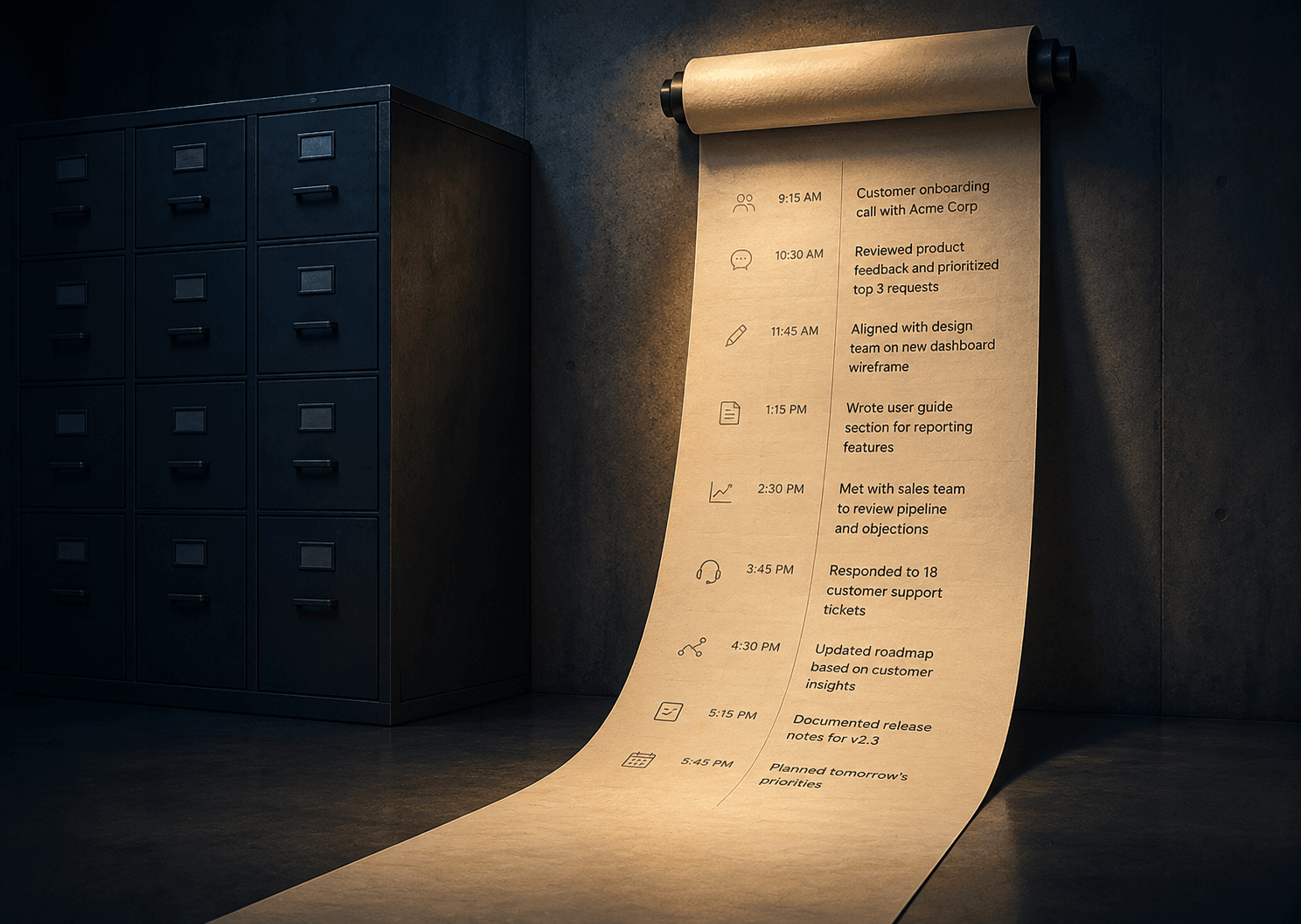
The Action Log is proof-of-work you can scroll, not a compliance artifact you file. Same record, founder point of view.

The log built for the person who has to trust it

So the bar any honest answer has to clear is this: capture everything the AI did, keep it tamper-evident, and render it so a non-engineer can read it and believe it. The capture and the tamper-evidence are table stakes that serious tools already meet. The legibility is the part almost everyone misses, and it is the part a founder actually buys.

JynAI built Works, an AI Business OS, to clear that bar by default. The proof of the work is not something you go find. It is sitting there, readable, in the parts of the product you use every day.

  • Job is answering “what did the AI do this week” without asking an engineer.
    Works logs every run, action, and outcome and versions it, so the cross-workspace Activity log is a plain list you scroll, filterable by time, area, agent, or workflow.
    Gain is a weekly answer you can point at instead of describe.

  • Job is recognizing the work, not decoding it.
    Each per-agent action log records the agent, the tool it called, the result, and the timestamp in readable terms, so the record reads like an ops update rather than a stack trace.
    Gain is trust from seeing, not from a summary tile.

  • Job is knowing the record was not quietly changed.
    Works keeps artifact versioning append-only, so previous plans and outputs are never lost and the tamper-evidence point is answered without a founder ever thinking about it.
    Gain is a record that holds up.

  • Job is showing a partner or the board, fast.
    Works rolls outcomes up at the area and workspace level and exports the activity log and rollups to a board deck in docx, xlsx, or pdf.
    Gain is proof that comes out of the product, not out of a weekend spreadsheet.

The price makes the claim honest. The full capability set unlocks on the $49 Pro tier, not behind an enterprise contract, which is the proof that a founder-led business gets this without a compliance budget. And we run on it ourselves: at Machintel, AI went live across six teams in ninety days, and the record of what it did was readable from the first week.

See every action AI took. Get early access. Or if you want the proof shape first, ask for the proof-of-work example and see what a scrollable Action Log actually reads like.

Common Questions

What is an AI action log?

An AI action log is the automatic, append-only record of everything an AI agent did while it worked: every tool call, the data it touched, the decision it made and why, the result, and a timestamp on each entry. Unlike a compliance audit trail built for a regulator, its primary reader is the person running the business, so legibility is as required as completeness. See how within-team visibility works for where the log sits in day-to-day operations.

Is an action log the same as an audit trail?

The data is the same; the reader is not. An audit trail is built so an auditor or a machine can verify behavior, which makes it dense and technical. An action log is the same complete record rendered so the person running the business can read it and trust it. One was written for a regulator, the other for you.

Does the log have to be tamper-evident?

Yes. A log you can silently edit proves nothing, because it could have been changed after the fact. A trustworthy action log is append-only, so entries are preserved and the record holds up as evidence. This is also what the new EU rules require of the systems they cover.

How is this different from measuring whether AI is working?

The action log shows what the AI did. Telling which of those actions actually moved a number is a separate question, answered by honest attribution, and auditing your overall AI spend is its own exercise covered in the honest AI audit. The log is the raw proof; attribution is the interpretation.

Why does this matter if no one on my team distrusts the AI?

Because doubt that is never surfaced is the version that quietly stalls adoption. Eighty-four percent of developers use or plan to use AI while 46 percent distrust the output accuracy, meaning the discomfort runs well ahead of anyone saying so. A readable record means no one has to voice the suspicion; they can simply look. The named version of that dynamic is in the quiet suspicion.

Get Started With AI

Are You Ready to Make AI Work for You?

Simplify your AI journey with solutions that integrate seamlessly, empower your teams, and deliver real results. Jyn turns complexity into a clear path to success.

See AI for Real Business Impact in Action →

ai that powers your team 226d8ee5db

See exactly what your AI did this week

An action log you can scroll in plain English, not a compliance trail you file for an auditor.
Technology
By Mark Choudhari · Jun 7, 2026 · 6 min read

What did the AI actually do this week.
Made with Works

TL;DR

An AI action log is the running record of what the AI did: every tool call, the data it touched, the result it produced, and when. Compliance frames it as an audit trail for a regulator. A founder needs the same record rendered in plain English they can scroll this week and trust.

In this article

What did the AI actually do this week, in plain English

Most founders cannot answer this, and it is the first question that matters. The work happens somewhere you cannot see, and the honest report at the end of the week is a feeling, not a record. An action log answers it directly: a readable, scrollable list of every action the AI took, in the order it took them, in words you do not need an engineer to translate.

That sounds basic, and it is exactly the thing the market skips. The tools optimize for the dashboard, the rolled-up number that says forty-two tasks ran. A founder does not trust a business on a number that says forty-two. They trust it the way they trust a good ops update, by reading what actually happened and recognizing the work. The action log is that update, produced automatically, so “what did the AI do this week” stops being a shrug and becomes something you can point at.

A dashboard shows totals. The record that earns trust shows the decisions underneath them.

Sentry, AI agent observability, 2026

What is an AI action log, and what should it track

An AI action log, also called an agent activity log or audit trail, is the automatic record of everything an AI did while it worked. It should track each tool the AI called, the parameters it used, the data it accessed, the decision it made and the reason for it, the result it produced, and a timestamp on every entry. That is the full, honest list. The engineering guides agree on it, and so increasingly does the law.

The reason the list is this specific is that an AI agent does things an ordinary app log was never built to capture. LoginRadius lays out the prompt-context-action loop and the field set an agent audit log needs, down to which identity acted, what it was allowed to do, and the reasoning trace behind the action. The EU AI Act now requires high-risk systems to automatically record events over the lifetime of the system, so this is no longer a nice-to-have for the teams it covers. The capture problem is largely solved. What almost no one solves is making the captured record readable by the person who actually has to trust it.

One more property is not optional: the record has to be tamper-evident. A log you can quietly edit proves nothing, because anyone could have changed it after the fact. The practitioners writing about the new rules are blunt that a silently alterable log has zero evidentiary value. An action log worth trusting is append-only by design.

Can I get a running log I can scroll instead of trusting a dashboard

Yes, and the difference between the two is the whole point. A dashboard summarizes. A running log preserves the sequence, so you can scroll the actual actions in order rather than trusting a count that hides them. For a founder, the scrollable record is the trustworthy one, because trust comes from seeing the work, not from a tile that says it happened.

The distinction has a clean name in the field. iSimplifyMe puts it as logs prove the agent acted, while an audit trail proves it was entitled to act and explains why, and notes that a large share of teams still lack an evidence-quality trail at all. The founder version is simpler than the compliance version but asks for more in one way: it has to be legible. A trail that satisfies an auditor and a trail you can read over coffee are built from the same data, but only one was written for you.

What counts as proof-of-work for an AI versus a person

With a person, proof of the work is implicit. You see them at their desk, you get the update in the meeting, you watch the deal move. With an AI, none of that is visible, so the proof has to be explicit or it does not exist. Proof-of-work for an AI is the action log itself: a complete, readable, tamper-evident record of what it did, available the moment you want to check.

This is why “we are using AI” is not an answer and a scrollable record is. WorkOS argues that building agent audit logs is the foundation that makes agent features trustworthy enough to ship in the first place. The proof is not a report you commission after the fact. It is the by-product of the work, captured as it happens. ARMO frames the minimum version as the smallest set of events any trail must answer for after an incident. A founder does not need the minimum-viable audit trail an engineer would build. They need the maximum-readable one, and those are closer than they sound: the same record, rendered for a different reader.

The Action Log is proof-of-work you can scroll, not a compliance artifact you file. Same record, founder point of view.

The log built for the person who has to trust it

So the bar any honest answer has to clear is this: capture everything the AI did, keep it tamper-evident, and render it so a non-engineer can read it and believe it. The capture and the tamper-evidence are table stakes that serious tools already meet. The legibility is the part almost everyone misses, and it is the part a founder actually buys.

JynAI built Works, an AI Business OS, to clear that bar by default. The proof of the work is not something you go find. It is sitting there, readable, in the parts of the product you use every day.

  • Job is answering “what did the AI do this week” without asking an engineer.
    Works logs every run, action, and outcome and versions it, so the cross-workspace Activity log is a plain list you scroll, filterable by time, area, agent, or workflow.
    Gain is a weekly answer you can point at instead of describe.

  • Job is recognizing the work, not decoding it.
    Each per-agent action log records the agent, the tool it called, the result, and the timestamp in readable terms, so the record reads like an ops update rather than a stack trace.
    Gain is trust from seeing, not from a summary tile.

  • Job is knowing the record was not quietly changed.
    Works keeps artifact versioning append-only, so previous plans and outputs are never lost and the tamper-evidence point is answered without a founder ever thinking about it.
    Gain is a record that holds up.

  • Job is showing a partner or the board, fast.
    Works rolls outcomes up at the area and workspace level and exports the activity log and rollups to a board deck in docx, xlsx, or pdf.
    Gain is proof that comes out of the product, not out of a weekend spreadsheet.

The price makes the claim honest. The full capability set unlocks on the $49 Pro tier, not behind an enterprise contract, which is the proof that a founder-led business gets this without a compliance budget. And we run on it ourselves: at Machintel, AI went live across six teams in ninety days, and the record of what it did was readable from the first week.

See every action AI took. Get early access. Or if you want the proof shape first, ask for the proof-of-work example and see what a scrollable Action Log actually reads like.

Common Questions

What is an AI action log?

An AI action log is the automatic, append-only record of everything an AI agent did while it worked: every tool call, the data it touched, the decision it made and why, the result, and a timestamp on each entry. Unlike a compliance audit trail built for a regulator, its primary reader is the person running the business, so legibility is as required as completeness. See how within-team visibility works for where the log sits in day-to-day operations.

Is an action log the same as an audit trail?

The data is the same; the reader is not. An audit trail is built so an auditor or a machine can verify behavior, which makes it dense and technical. An action log is the same complete record rendered so the person running the business can read it and trust it. One was written for a regulator, the other for you.

Does the log have to be tamper-evident?

Yes. A log you can silently edit proves nothing, because it could have been changed after the fact. A trustworthy action log is append-only, so entries are preserved and the record holds up as evidence. This is also what the new EU rules require of the systems they cover.

How is this different from measuring whether AI is working?

The action log shows what the AI did. Telling which of those actions actually moved a number is a separate question, answered by honest attribution, and auditing your overall AI spend is its own exercise covered in the honest AI audit. The log is the raw proof; attribution is the interpretation.

Why does this matter if no one on my team distrusts the AI?

Because doubt that is never surfaced is the version that quietly stalls adoption. Eighty-four percent of developers use or plan to use AI while 46 percent distrust the output accuracy, meaning the discomfort runs well ahead of anyone saying so. A readable record means no one has to voice the suspicion; they can simply look. The named version of that dynamic is in the quiet suspicion.

Get Started With AI

Are You Ready to Make AI Work for You?

Simplify your AI journey with solutions that integrate seamlessly, empower your teams, and deliver real results. Jyn turns complexity into a clear path to success.


See AI for Real Business Impact in Action →

ai that powers your team 226d8ee5db